

Drafting a Sword-and-Sorcery Framework: What Makes This Genre Work Across Any TTRPG?

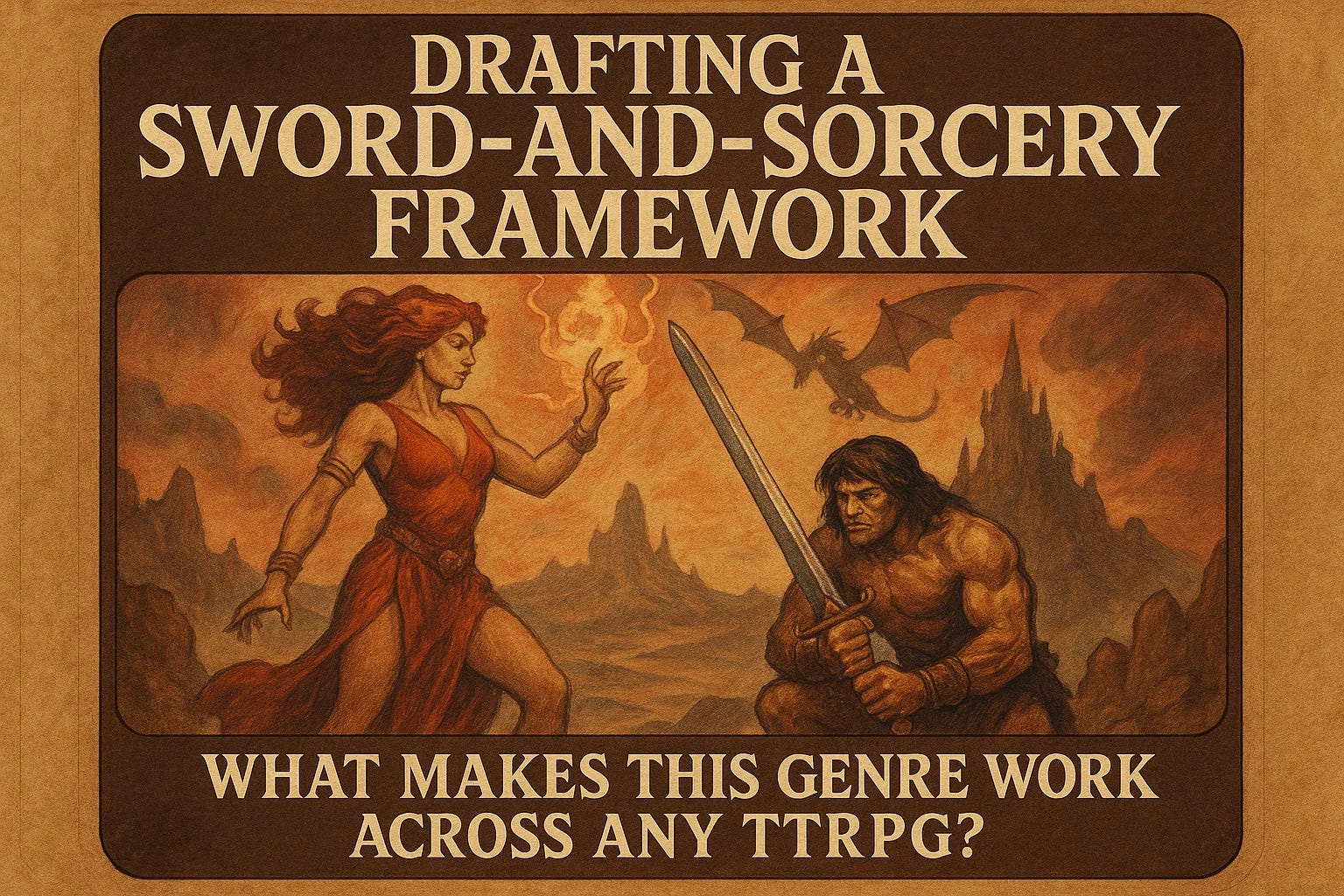
I’m still wrestling with the core design of this thing, I don’t even have a title yet, just a working draft and too many questions. What actually makes a story sword-and-sorcery, and what framework procedures can I develop that would make any TTRPG feel like this genre?
Personal Stakes Over World-Ending Threats
The first thing that distinguishes sword-and-sorcery from high fantasy is the scale of conflict. These aren’t stories about saving the world or fulfilling ancient prophecies—they’re about personal goals, survival, and immediate problems. Conan raids a city to rescue someone or steal treasure, not to prevent the Dark Lord from unmaking reality. The famous paraphrase puts it perfectly: “Conan strides into Omelas, frees the child easily, and carries him out while the town burns down behind him”.
So what framework procedure enforces this regardless of the underlying system? Maybe a stake-setting rule that caps objectives: no world-saving, only personal motivations like revenge, wealth, or freedom. Perhaps a scene framing guideline that always asks “what does this character want right now?” rather than “what does the party need to accomplish?” Could there be a veto mechanism for scope creep—a way to redirect epic quests back to immediate, tangible goals?
Moral Ambiguity and Situational Ethics
Sword-and-sorcery “eschews overarching themes of ‘good vs evil’ in favor of situational conflicts that often pit morally gray characters against one another”. Heroes might ally with enemies or sacrifice companions to survive. This isn’t about heroic virtue, it’s about cunning and physical strength as the primary tools for navigating a gritty, dangerous world.
What universal framework supports this across different systems? Maybe an alignment override that replaces any existing morality mechanics with reputation tracks or faction standing. The framework could include guidelines for temporary alliances, mechanical incentives for pragmatic betrayal or situational cooperation. How do I make this work whether the base system is D&D, Fate, or something narrative-focused? Does the framework need conversion tables for different mechanical approaches?
Magic as Mysterious and Costly
One interview defined it cleanly: “Magic exists, but no magic systems”. In sword-and-sorcery, magic has mysterious origins and substantial costs. Heroes rely on swords and wits; villains wield sorcery. Characters care that magic works, not how it works.[7][8]
This is tricky as a framework, every TTRPG handles magic differently. What overlay procedure works universally? Maybe magic cost modifiers that add risk regardless of the base system: corruption points, unpredictable effects tables, or mandatory narrative bargains. The framework could restrict player access to magic by default, offering guidelines for converting wizard-type characters into dabblers or sword-wielders who occasionally use magic items. Should there be a universal “sorcery corruption” subsystem that plugs into any game’s existing mechanics?
Action Over Worldbuilding
Sword-and-sorcery is “action-oriented” with “straightforward plots”. The world might be vast, but “its vast history is not so important to the characters”. Getting from point A to point B swiftly, with obstacles overcome through combat and cunning.
The framework needs pacing procedures that work across systems. Maybe scene economy rules: cut to conflict, limit investigation scenes, encourage aggressive action. Could there be a universal turn structure, alternating action beats and brief interludes, that overrides the base system’s exploration procedures? What about mechanical rewards for decisive action versus penalties for excessive planning? How do I make this compatible with both traditional and narrative systems?
Gritty Realism and Cosmic Horror
The genre is “grounded in real-world social and societal hierarchies, and is grittier, darker, and more violent, with elements of cosmic or Lovecraftian creatures”. The settings pull from archaeology, theosophy, alternate history, Earth’s mythical past or far future rather than purely invented worlds.
What framework overlays create this atmosphere? Maybe injury escalation rules that make any system’s combat more consequential, adding lasting wounds or complications regardless of whether the base game uses hit points, stress tracks, or narrative health. Should the framework include setting generation procedures that emphasize ruined civilizations and decadent cities? Or is it better to provide aesthetic guidelines that work with any existing setting?
Antihero Protagonists
The typical protagonist is “an antihero who fights against supernatural evil and the occult” but “may ally with an enemy or sacrifice an ally in order to survive”. These are barbarians, rogues, mercenaries, not noble knights.
The framework needs character reframing tools that adapt any system’s archetypes. Procedures for converting paladins into mercenaries, wizards into reluctant dabblers, clerics into cynical survivors. Maybe starting motivation tables that work universally, selfish or pragmatic goals that override heroic class fantasies? Should advancement be redirected toward treasure and reputation in all systems, or does each base game need custom guidance?
What Still Needs Answering
I’m still not clear on several framework design questions:
How do I create procedures flexible enough to work with both crunchy traditional RPGs and narrative-light systems?
Should the framework include conversion guidelines for specific popular systems, or aim for total system-agnosticism?
What’s the minimum viable framewor, what essential procedures actually make sword-and-sorcery happen at the table?
Do I need separate tracks for adapting combat-focused versus story-focused games?
How do I balance “framework as overlay” with “framework as replacement”, when do my procedures modify the base system versus when do they override it entirely?
The more I read about sword-and-sorcery, from Howard’s Conan to Moorcock’s Elric to modern works, the more I realize the genre works by limiting scope and complicating choices rather than expanding possibilities. This framework needs procedures that narrow focus to the immediate, the personal, and the dangerous, no matter what system sits underneath. Less “save the kingdom,” more “escape with the loot before the temple collapses.”
Maybe that’s the core design principle: every framework procedure should ask “does this keep things immediate, morally gray, and action-focused regardless of base system?” If not, it doesn’t belong in this framework.
Think about pulp noir. The two genres are brothers, many writers wrote both. Barring the character & setting genre dressing, the two are the same underneath. Pulp noir did sometimes have mysterious magical villains.