

Loner: Rocketpunk

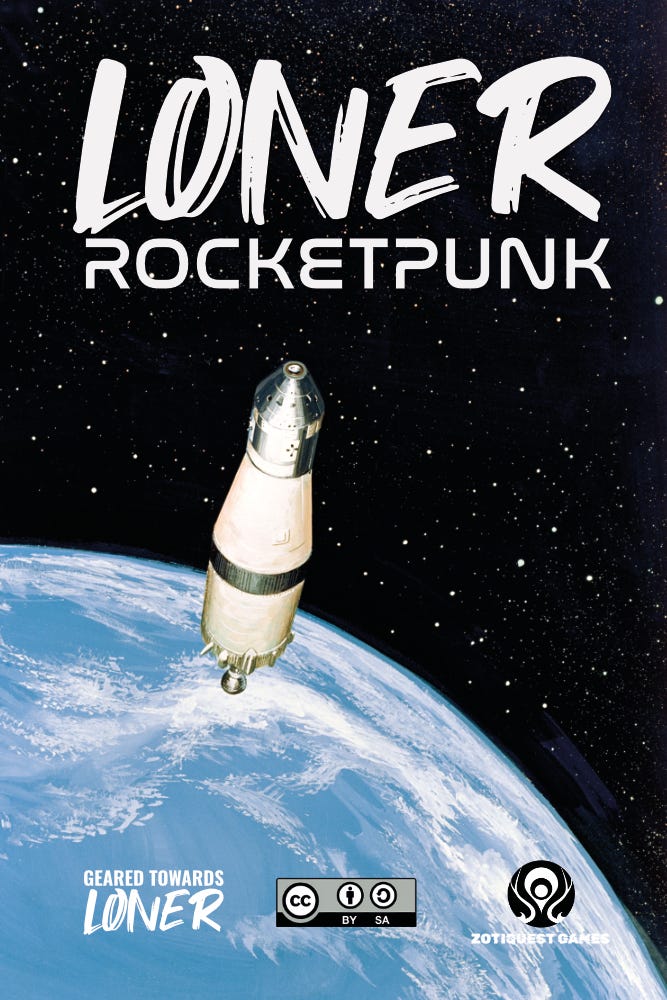
Yesterday I wrote about rocketpunk as a genre: the science fiction that takes the rocket equation seriously enough to let it hurt, that trades warp drives for delta-v budgets and force fields for spin gravity. I didn’t mention at the time that I’d already spent the better part of a year building a game inside that genre. Today I’m putting it in your hands. It’s called Loner: Rocketpunk, and it’s a solo tabletop RPG set in a 2026 where the Cold War never left orbit.
I want to talk about why I made it, and what it actually is, before I talk about what’s in the box.
The Premise I Couldn’t Shake
The setup is simple to state: Sergei Korolev survives a routine surgery in 1966 that killed him in our timeline, and the Soviet space program doesn’t lose its chief architect at the exact moment it needed him most. The N1 rocket gets the reliability engineering it never got in reality. The competition with Apollo doesn’t slacken after 1969, it sharpens. Both superpowers keep building, keep funding, keep racing, because neither one can afford to be the side that stopped first.
Nothing else about the twentieth century needs to change for the rest to follow. Lunar bases by the 1980s. Mars settlements by the 2000s. Asteroid mining around Ceres and Vesta by 2011. A hybrid UN-style regulatory body, the Orbital Nations Alliance, trying to keep order across a solar system that’s been claimed a dozen different ways by governments and corporations who don’t fully trust each other. By 2026, where you play, there are people who were born on Mars. They’re five years old. Nobody quite knows what that means yet, for them or for the species.
I didn’t invent this idea, not really. It’s the premise of For All Mankind, and it’s been sitting in the back of science fiction for decades, this quiet what-if about a future we were, for a few years in the 1960s, actually building toward. What I wanted was to hand someone the controls of that future and let them live in it for an evening, alone, with four dice and a pencil.
Why Solo, and Why Rocketpunk Specifically
I play a lot of solo RPGs. There’s something about sitting with a game by yourself, letting an oracle answer questions you don’t know the answer to, that produces a particular kind of story you can’t get any other way. No one is performing for you. No one is managing pacing on your behalf. You ask the dice a question, and then you have to live with whatever they tell you.
Rocketpunk turned out to be an unusually good fit for that mode of play, and it took me a while to understand why. Most solo RPGs are journaling games or dungeon crawls, built around exploration or introspection. Rocketpunk fiction is built around constraint: limited fuel, limited air, limited time before the next resupply. A solo player is already working under constraints of their own, the ones that come from being one person doing a job a whole table usually splits between six. Put those two kinds of pressure together and they reinforce each other instead of fighting. Every choice in a Loner session already carries weight because it’s yours alone. Every choice in a rocketpunk story already carries weight because the delta-v doesn’t lie. The overlap felt less like a design decision and more like something I noticed was already true.
What’s Actually in the Book
I built Loner: Rocketpunk around four commitments, and I held to them stubbornly enough that they shaped almost every other decision in the text.
Portable. You need four six-sided dice, two colors, and something to write with. That’s the whole kit. I wanted a game you could run from a jacket pocket on a train, not one that needs a shelf.
Rules-light. There’s one core resolution mechanic. You learn it in the first session and you’ll have it memorized by the second. I kept cutting subsystems out of early drafts because I noticed I was building them to feel productive, not because the game needed them.
Tag-based. Characters, ships, locations, NPCs, even a malfunctioning airlock, are all described the same way: with descriptive tags instead of numeric stats. Your protagonist isn’t a spreadsheet of attributes. They’re a Radiation-Scarred Salvage Operator with a Debt to a Crime Syndicate and a Jury-Rigged Thruster Pack, and those descriptions do the mechanical work that numbers would do in another system. When a tag is relevant to what’s happening, it shifts the odds. When it isn’t, it’s just true about the character and stays out of the way.
Emergent and open-ended. There’s no plot in the book for you to walk through. The Oracle answers yes-or-no questions, weighted by how likely you judge the answer to be, and the story gets built out of your questions and its answers, session by session. Nobody wrote the ending in advance. Including me.
Everything else in the book, the character creation tables, the timeline of the divergence from our own history, the shipyard full of named vessel classes, the situation tables for when you need a scene to start moving, exists to serve those four commitments rather than to pad the page count. If a table didn’t earn its place, I cut it.
The Parts I’m Proud Of
The tag system is the thing I’d point to first. I spent a long time trying to make a numeric skill system work for solo play before I gave up on it entirely. Numbers are precise, but precision wasn’t actually what the game needed. What it needed was for a character’s history to matter mechanically without turning character creation into an accounting exercise. Vacuum Specialist tells you something a “+2 to EVA checks” never will, and it still does exactly the same job at the table when you roll.
I’m also proud of the setting’s restraint. It would have been easy to let the alternate history run wild, to pile on speculative technology until it stopped resembling anything we could plausibly have built. I kept pulling it back. Analog electronics stay analog because vacuum tubes actually are more radiation-resistant than early solid-state components, and in a timeline where nobody skipped a decade of hardening research, that fact still matters in 2026. The bulky suits stay bulky because that’s what life support looks like when you’re not allowed to invent your way past physics. Every retro detail in this book is there because it’s still true, not because it’s aesthetically pleasing. The aesthetic came out of the truth, not the other way around.
What I Hope Happens Next
I don’t have a launch trailer for this. I don’t have a marketing plan. What I have is a game I wrote because I wanted to play it, and a genuine curiosity about what happens when other people sit down with it and start asking the Oracle questions I never thought to ask.
If you play a session, I’d like to hear what your character’s frailty turned out to cost them. I’d like to know which tag ended up mattering more than you expected when you wrote it down. That’s the whole reason I built this the way I did: not to hand you a story, but to hand you the tools to find out what your story is, four dice and a pencil at a time.
The future we almost had is yours now. Go build it.