

Rocketpunk: The Future We Almost Built

There’s a particular kind of science fiction that doesn’t dream in warp drives or laser swords. It dreams in delta-v budgets, in the groan of a hull under spin gravity, in the terrible arithmetic of how much reaction mass you’ll need to slow down again once you’ve sped up. This is rocketpunk, and even if you’ve never heard the term, you’ve probably felt its gravity anyway: through For All Mankind, an Atomic Rockets deep-dive at 2am, or a tabletop game where your ship’s engine has a real name and a real exhaust velocity.
Rocketpunk is what happens when science fiction takes the “science” half of its name seriously enough to let it hurt.
What Rocketpunk Actually Is
The term itself is younger than the genre it describes. It’s most associated with the blog Rocketpunk Manifesto, written by Rick Robinson in the mid-2000s, which used it to describe a specific flavor of “in-system” science fiction: stories confined to our own solar system, powered by extrapolations of real rocketry rather than invented physics. No warp drives, no wormholes, no convenient artificial gravity fields humming away in the background. Just thrust, mass, and time: the three things that actually govern how you get from Earth orbit to the Jovian moons.
Where space opera asks “what if we could go anywhere, instantly, and it were easy?”, rocketpunk asks “what if we could only go where the rocket equation allows, and it were brutally hard?” That single shift in assumptions changes everything downstream of it. Distance becomes a character. Fuel becomes a plot device. A trip to Mars isn’t a scene transition; it’s an ordeal measured in months, with its own dangers, its own economy, its own psychological toll.
This is science fiction with its shoes on the ground, even when the ground is four hundred million kilometers away.
The Rocket Equation Is the Genre’s God
Every rocketpunk story lives or dies by one piece of math: the Tsiolkovsky rocket equation, which relates a spacecraft’s change in velocity to how much propellant it burns and how efficiently it burns it. It’s not exciting to look at. But its consequences ripple through everything the genre cares about.
Because propellant is heavy, and heavy things are expensive to launch, every gram of reaction mass a ship carries is a gram it had to justify. That means ships in rocketpunk fiction don’t casually change course, don’t outrun pursuers with a dramatic burst of speed, don’t loiter indefinitely waiting for the plot to catch up. They commit to trajectories the way a diver commits to a dive. Once you’ve burned the fuel for a transfer orbit to Ceres, you’re going to Ceres, on a schedule set by orbital mechanics rather than narrative convenience.
This produces a very particular kind of tension. Rocketpunk stories are full of characters doing the math out loud: checking whether they have enough delta-v for a rendezvous, whether a rescue burn will leave them stranded, whether the numbers on the fuel gauge are lying by even a percentage point. It’s a genre where a spreadsheet error can be as lethal as a villain.
No Force Fields, No Free Lunch
Compare this to the assumptions baked into most popular space fiction. Star Wars ships bank and swoop through vacuum like fighter jets in an atmosphere, because nobody involved was trying to model orbital mechanics; they were making a war movie in space. Star Trek ships have inertial dampeners and artificial gravity as background furniture, technologies so taken for granted they’re rarely even named on screen. These aren’t criticisms; those shows are doing something else entirely, and doing it well. But rocketpunk draws its line in a different place.
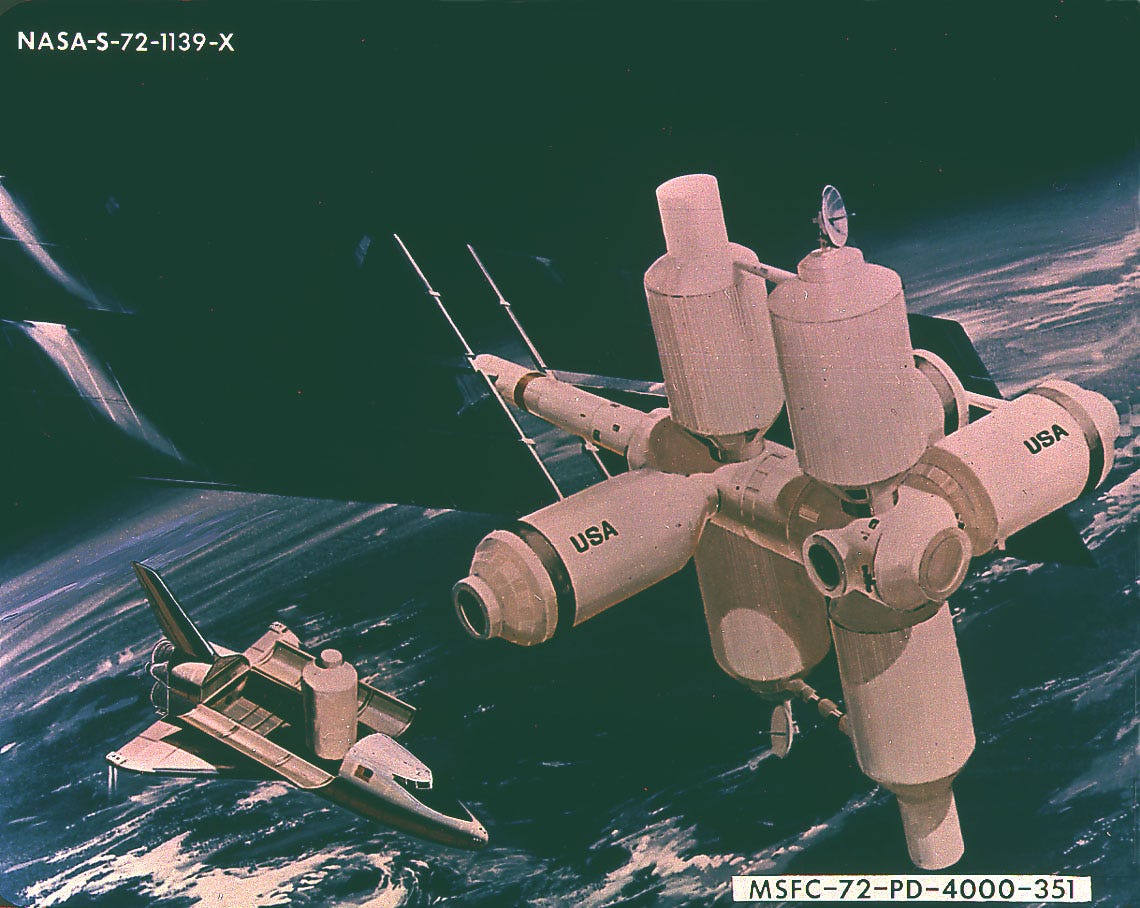
In a rocketpunk story, gravity mostly comes from spin: a rotating hab ring or a tethered counterweight, with the attendant Coriolis effects that make a bucket of water behave strangely and a thrown ball curve wrong. Radiation is a constant hazard, not a plot-convenient obstacle that shows up for one episode. Vacuum kills you not with a suit breach and a soundtrack sting, but with cold, mundane speed. Ships look less like sleek arrows and more like ungainly assemblies of fuel tanks, radiators, and habitat modules bolted around a drive stage, because that’s what you get when form has to follow the actual function of surviving in space rather than looking heroic silhouetted against a nebula.
The absence of technobabble shortcuts is the point. When you can’t invent your way out of a problem, the problem becomes the story.
A Genre With Deep Roots
Rocketpunk didn’t spring up whole in the 2000s; it’s a return trip to a much older tradition. You can trace a direct line back to the “hard SF” writers of the mid-20th century: Robert Heinlein’s juveniles, with their meticulous descriptions of orbital rendezvous and lunar economics; Arthur C. Clarke, an actual satellite-communications pioneer who wrote fiction the way an engineer sketches blueprints; the whole tradition of magazine SF that treated the solar system as a frontier you’d have to earn, mile by expensive mile.
The visual language has its own lineage too. Chris Foss’s paintings of bulbous, industrial spacecraft, all pipes and tanks and sun-bleached hull plating, shaped how a generation pictured what “realistic” spaceships should look like: not aerodynamic, because there’s no air to be aerodynamic in, but functional in the way an oil tanker or a drilling rig is functional. The Terran Trade Authority books of the 1970s did something similar, presenting invented spacecraft with the deadpan technical specificity of an aircraft recognition manual.
More recently, the genre found a second wind. For All Mankind is probably rocketpunk’s most visible modern ambassador: an alternate history in which the Space Race never ended, built almost entirely on the premise that if we’d simply kept funding the hardware, the rest would follow. Its drama comes from EVA checklists, docking procedures, and the political will to pay for delta-v, not from any invented physics; the show’s tension is generated by the same unglamorous math that governs the rest of the genre. Andy Weir’s The Martian is rocketpunk distilled to a single, obsessive question: given what we actually know about rocket science, botany, and chemistry, how does one man survive Mars with nothing but competence and duct tape? The film Gravity spent ninety tense minutes proving that orbital mechanics alone, without a single alien or laser, can carry an entire thriller.
The genre’s prose tradition never really went away, either. Allen Steele’s Near Space novels, beginning with Orbital Decay, read like they were written by someone who’d actually worked a shift on a space station: unionized construction crews, budget overruns, and the unglamorous labor of building infrastructure in orbit. Ben Bova’s Colony, part of his sprawling Grand Tour sequence, works the same seam from the other direction, following the political and economic strain of building a permanent settlement at L5. Both writers treat spaceflight the way a labor novelist treats a factory floor: as a workplace first, an adventure second.
It’s worth remembering, too, that rocketpunk was never purely a fiction project. Some of its most load-bearing ideas came from engineers and physicists writing non-fiction, not novelists writing speculation. Gerard K. O’Neill’s The High Frontier is probably the single most influential of these: a serious, technically grounded proposal for building rotating space colonies at the Earth-Moon Lagrange points, complete with mass drivers, solar power satellites, and population projections. O’Neill wasn’t writing science fiction; he was writing an engineering argument. But the cylinders and tori he sketched became the default architecture for “realistic” space habitats in fiction for decades afterward. A rocketpunk writer describing a spinning habitat, however casually, is almost always describing an O’Neill cylinder whether they credit him or not.
Why the Constraints Are the Appeal
It would be easy to assume a genre this committed to realism is just science fiction for people who enjoy homework. That’s not quite it. The appeal of rocketpunk isn’t the math for its own sake; it’s what the math forces the story to be about.
When ships can’t just go anywhere, distance becomes consequential again, and so does isolation. A crew stranded past Jupiter isn’t a phone call away from rescue; they’re weeks or months from anyone who could help, and every decision they make has to account for that. When fuel is finite and expensive, economics stops being background texture and becomes the engine of conflict: who controls the mass drivers, who owns the water ice on that asteroid, who can afford the delta-v to enforce a claim nobody else can reach in time to contest it. When gravity is manufactured by spin rather than assumed, the body itself becomes a site of story: bone density loss, vestibular disorientation, the particular vertigo of walking “up” a curved deck.
Rocketpunk trades the infinite playground of space opera for something narrower and, often, sharper: a solar system that behaves like the one we actually live in, populated by people who have to solve problems the way engineers solve problems, under constraints that don’t bend for anyone’s convenience. The drama comes from ingenuity operating at the edge of what physics allows, not from physics quietly stepping aside.
Playing It at the Table
This is also, not coincidentally, a genre that translates unusually well to tabletop RPGs, because tabletop play already rewards the kind of granular, consequence-driven decision-making rocketpunk fiction is built on. A game where your ship’s propulsion type is a mechanical fact, where an ion drive gives you efficient, patient acceleration and a nuclear pulse rocket gives you brutal thrust at the cost of everyone’s nerves, turns “how do we get there” into a real question with real trade-offs, not a formality on the way to the next set piece.
Settings built on this foundation use the same textures the fiction does: debris cleaners and space miners as viable, dignified professions rather than backstory color; a taxonomy of real propulsion concepts (ion, nuclear-thermal, mass driver, solar sail, nuclear pulse) that players learn to reason about the way they’d learn a magic system elsewhere; starship classes defined by mission profile rather than aesthetics. It’s a genre where knowing your ship’s specs isn’t optional trivia. It’s how you survive the session.
Played well, a rocketpunk table has the same texture as the best of the genre’s prose: quiet stretches of real tension while a burn completes, sudden crises when a number doesn’t add up, and a sense that the universe isn’t rooting for you or against you; it’s just indifferent, and that indifference is the whole challenge.
The Future That Might Still Happen
Part of what keeps rocketpunk relevant, even decades on, is that it isn’t really about some other future. It’s about the plausible one: the solar system we could, with enough will and enough decades, actually go build. Warp drives ask nothing of us but imagination. Rocketpunk asks whether we could really do this, with the physics we’ve already got, if we decided it mattered enough.
That’s a heavier kind of speculation than most science fiction bothers with. It’s also, for a certain kind of reader and a certain kind of player, the only kind that feels like it counts.