


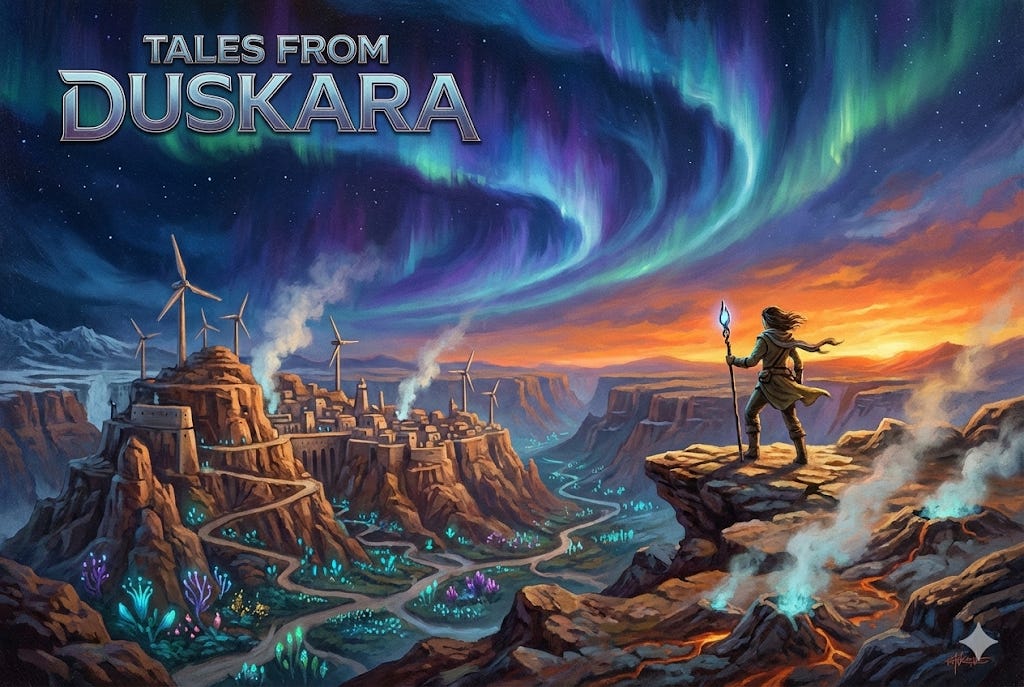
1. The Calm Before the Storm
At the caravan’s edge, where the wind carved patterns through rust-colored dust, Kael kin-Hanga Thornvale and Arden kin-Hanga Lyris sat cross-legged at the focal point, a natural amphitheater of stone where three wind currents converged, creating harmonics that rang like distant bells. Kael’s scarred hands rested palm-down on his knees, feeling the vibration through rock and bone, while Arden’s fingers traced slow spirals in the air, reading the atmospheric pressure shifts the way other men read text. The meditation was both spiritual practice and practical necessity: the wind held information for those patient enough to listen.
Arden’s breath hitched, just slightly, and his left temple showed a faint sheen of sweat despite the cool twilight air. The strain of weatherworking, even this subtle reading, left marks. Kael opened his eyes, catching the weatherworker’s pale gaze. Neither spoke. The wind carried its own warnings, a metallic pressure building somewhere beyond the eastern ridges.
Behind them, the caravan assembled for the morning forum. Thirty-seven people—traders, handlers, a blacksmith, three guards, and the psychically gifted who kept them alive—gathered in a loose circle around the lead wagon where the route maps lay weighted against the constant breeze. Mara kin-Hanga Zhayar stood near the wagon’s edge, her mechanical left arm clicking softly as she adjusted a strap, and Kael watched her fingers brush the small wind-token hanging from her belt before she spoke. The gesture was automatic, reverent, a prayer disguised as habit.
“Straight through the Flats, or swing wide toward the Nightward Edge?” Mara asked, her voice carrying the practical edge that made her invaluable, but her eyes flicked skyward briefly, reading signs Kael couldn’t see.
An elder trader named Vess, whose family had run these routes for three generations, stepped forward. His water flask, battered copper, no larger than a fist, hung prominent at his hip, and he unscrewed the cap to take a single, measured sip before speaking. “The Flats cut two days off our time. The crystals need to reach Aetherion before the Gradient Feast, or Harmattan’s Reach goes without thermal regulators through the cold wind phase.”
Beside him, a young woman with the focused gaze of the psychically attuned placed her hand flat against the wagon bed, her fingers splayed wide. Denna, the caravan’s thermal sensor, frowned as she read the geothermal signatures bleeding up from deep aquifers. “The temperature gradient is steeper than it should be this close to the central belt. The night-side air is pushing harder than usual.”
Arden rose from his meditation spot, joints unfolding with deliberate care, and when he reached the circle his fingers trembled, barely perceptible, but Mara’s eyes tracked the movement. “The storm wall is closer than the maps show” he said quietly, each word measured against the effort it took to shape them after extended atmospheric reading. “I can feel the pressure building where day-heat meets the night-cold. It’s not immediate, but it’s coming.”
Kael didn’t issue orders. He met Vess’s eyes, then Mara’s, then looked to Arden, weighing the communal need against the weatherworker’s taut expression. “If we push through the Flats and the storm catches us exposed, we lose the cargo and probably half the caravan” he said, laying out the stakes rather than dictating the choice. “If we swing wide and miss the delivery window, Harmattan’s Reach faces cold without proper heating. What do we risk?”
The silence stretched, filled only by the wind’s constant voice and the creak of wagon frames. Vess murmured a blessing under his breath, old words about ancestors who walked the first routes, and placed a small iron charm on the map, its weight settling near the Flats route. Another trader added a carved wind-token beside it, then a third placed a stone near the longer path.
Mara broke the quiet with a sharp exhale that might have been a laugh or a prayer. “The crystals are packed in double-sealed crates with thermal baffling. They’ll survive rough handling. The question is whether we will.” She looked at Arden directly, and something unspoken passed between them, years of watching weatherworkers push too hard, collapse mid-storm, risk the psychic aberrations that formed when human minds bent the atmosphere beyond breaking.
Arden’s jaw tightened, but he nodded slowly. “I can manage the Flats if we move during the stable wind phase. But I’ll need Denna and anyone else with atmospheric sensitivity to share the load. Distributed effort.”
A wiry man named Torven, who carried the faint psychic signature of a water-finder, stepped forward. “I’ll monitor the moisture gradients. If the storm shifts, I’ll know before it hits.”
Kael looked around the circle, reading faces, watching the small rituals, hands touching tokens, lips moving in silent wind-blessings, eyes tracking the sky’s amber-and-ash gradations. This was consensus forming, not through vote but through the slow accumulation of shared understanding. “We take the Flats” he said finally, giving voice to what the circle had already decided. “But we watch the sky, and if Arden or Denna sense the storm closing faster than expected, we find shelter immediately. No debate.”
Vess nodded once, retrieving his wind-token with a murmured thanks to the ancestors. The forum dissolved into motion, traders securing cargo nets, Mara checking the reinforced wheel axles, Arden retreating briefly to a shaded spot where he pressed his palms against his temples, steadying himself.
The caravan moved steadily into the Flats, a landscape of low scrub and wind-polished stone where the twilight refracted through atmospheric dust in bands of copper and violet. The scent of geothermal sulfur rose faintly from vents marking old aquifer lines, mixing with the dry, electric taste that preceded storm activity. Twenty wagons stretched in a line, their wind-hardened frames creaking rhythmically, and atop the fourth wagon, the cargo glinted, crates filled with geothermal crystals, each one a condensed node of thermal energy harvested from deep-vent systems.
Iven kin-Hanga Kelthar, the caravan’s blacksmith, moved between wagons with his characteristic unhurried purpose, his massive hands checking straps and hitches, pausing occasionally to tighten a bolt or redirect a cargo net. His apprentice, a teenager named Kael, struggled with a stubborn buckle until Iven placed one scarred hand over the boy’s and showed him the proper angle, gentle instruction without words. The hammer-and-anvil token on Iven’s necklace caught the light briefly, a small sacred thing worn smooth by years.
Mara passed him, muttering something about thermal expansion and tolerance margins, but her hand brushed a wind-token tied to the wagon’s frame, another small blessing, half-hidden beneath sarcasm. She glanced at Kael, who rode at the caravan’s head, his eyes scanning the horizon with the systematic focus of someone who had made too many hard choices and carried them all.
Arden sat on the flatbed of the third wagon, his legs folded beneath him, hands moving in the slow spirals of active weatherworking. Denna sat beside him, her eyes closed, both of them reading the atmospheric dialogue—pressure shifts, temperature layering, the invisible architecture of wind. A thin line of blood traced from Arden’s left nostril, dark against his pale skin, and he wiped it away without breaking concentration.
The wind shifted.
It wasn’t dramatic—no sudden gust, no temperature drop—but every weatherworker in the caravan felt it. Denna’s eyes snapped open. Torven, walking beside the eighth wagon, stopped mid-stride, his hand rising instinctively toward the moisture-heavy air. Arden’s fingers froze mid-gesture, and when Kael looked back, the weatherworker’s expression had gone blank, all his attention turned inward to the vast atmospheric pressure bearing down from the storm wall’s approach.
Traders began securing loose items without being told—water flasks checked and double-sealed, tools stowed, personal belongings tied down. An older woman near the rear wagon made a warding sign with her fingers, tracing the symbol for wind-protection in the air, and two others echoed the gesture. No one panicked. Panic was a luxury Duskara didn’t permit.
Kael brought his wagon alongside Mara’s, close enough to speak without shouting over the wind. “How long?”
Mara glanced at Arden, reading the tremor in his shoulders, the way his breath had gone shallow. “He’s feeling it. Stronger than he expected.”
Arden turned his head slowly, and the effort it took to speak was visible—each word drawn from a well running dry. “Hours, not days. The pressure differential is collapsing faster than any pattern I know. Something’s wrong with the storm wall’s formation.”
Kael’s hands tightened on the reins, but his voice remained steady. “Can you hold it back? Buy us time to reach the waystation?”
The weatherworker’s silence was answer enough.
In the distance, beyond the eastern ridges where the sky darkened to charcoal and rust, the air began to shimmer with the first signs of atmospheric violence. The storm wasn’t here yet, but its shadow stretched long, and the wind carried the scent of ozone and distant ice, a promise written in pressure gradients and temperature flux.
The caravan moved forward, its fragile unity pulling thirty-seven lives through the narrowing window between safety and the planet’s indifferent wrath.
2. Approaching Danger
The caravan moved deeper into the Flats, where the land stretched featureless and exposed, only the faint shimmer of geothermal vents marking the aquifer lines below. The twilight refracted strangely here, copper bleeding into violet at the edges of vision, the air thick with the mineral weight of sulfur and the sharp, electric taste that clung to the back of the throat before storms. Kael’s wagon creaked steadily, its wind-hardened frame flexing against gusts that came in waves, predictable as breath until they weren’t.
Arden sat motionless on the flatbed of the third wagon, his hands moving in patterns so subtle they might have been mistaken for tremors. Denna crouched beside him, her fingers splayed against the wooden planks, reading the thermal signatures bleeding up from deep below, gradients that should have been gradual but felt jagged, wrong. Neither spoke. The atmospheric pressure was collapsing faster than any pattern either of them knew, a conversation between heat and cold that had abandoned its usual grammar.
The shift came without warning.
Arden’s hands stopped mid-gesture. His head tilted, as though listening to something just beyond audible range, and when he opened his eyes they were glassy, unfocused. A thin line of blood traced from his left nostril, dark against his pale skin, and his breath hitched, shallow and rapid. Denna’s gaze snapped to him, her hand reaching instinctively for his shoulder, but she didn’t pull him back. Not yet.
“It’s accelerating” Arden said, each word pulled from somewhere deep, somewhere that cost him. “The nightward air is pushing harder than it should. Temperature dropping too fast. This isn’t just unstable, it’s collapsing.”
Kael brought his wagon alongside, close enough to hear without shouting. Behind him, the caravan slowed, traders and handlers reacting to the change in rhythm even before anyone spoke. Mara appeared from the second wagon, her mechanical arm clicking softly as she gripped the frame for balance, and the wind-token at her belt swung in a tight arc, catching the dim light.
“How long?” Kael asked, his voice steady but his hands tight on the reins.
Arden wiped the blood from his lip with the back of his hand, leaving a smear across his knuckles. “Hours. Maybe less. The pressure differential, it’s not following any stable cycle. Something’s forcing the storm wall to collapse inward.”
Mara’s jaw tightened, her eyes flicking to the horizon where the sky had darkened from ash to charcoal, streaked with rust-colored bands that twisted like smoke in water. “Can you hold it back? Buy us time to reach the waystation?”
Arden’s silence was its own answer. His shoulders hunched, his breathing labored, and Denna placed her hand flat against his back, grounding him, sharing the psychic load in whatever small way she could. “If I push now, I collapse before the storm hits. And if I collapse” He didn’t finish. They all knew.
The risk of Weather Wraith formation hung unspoken between them, the psychic aberrations that formed when weatherworkers bent the atmosphere beyond breaking, destabilized energy coalescing into entities of elemental chaos that could devastate entire caravans. No one wanted to say it aloud.
Torven, the water-finder, jogged up from the eighth wagon, his expression grim. “Moisture gradient is shifting. The storm’s pulling everything toward its center, dry wind phase is coming early.”
Kael stood in his wagon, scanning the line of twenty vehicles stretched behind him, reading the tension in every face, the way hands moved to water flasks and wind-tokens without conscious thought. He could issue orders, drive faster, find shelter, prepare for the worst, but that wasn’t how this worked. Not on Duskara.
He looked to Mara, then to Arden, then to Vess, who had moved forward from the middle wagons, his weathered face unreadable but his hand resting on the wind-charm at his belt. “We need shelter” Kael said, laying out the problem rather than dictating the solution. “The waystation’s still two hours at this pace. If the storm closes faster, we’ll be caught exposed.”
“There’s nothing out here” Mara said, her voice flat. “No windbreaks, no caves. Just open ground.”
Vess cleared his throat, a soft sound that carried surprising weight. “The old maps show a ridge system about half an hour northeast. Might be overhangs, rock formations we can use.”
“Might be” Mara echoed, skepticism sharp in her tone.
Dren Callos pushed forward from the third wagon, his sunburnt face twisted in a scowl. “We stop now, set up what wind shields we have, maybe we ride this out right here. Better than chasing formations that might not exist.”
Kael met his eyes, recognizing the fear beneath the anger, the legitimate concern that came from years of watching caravans disappear into storms that promised mercy and delivered none. “Stop here, the storm overtakes us with no protection. The wagons won’t hold.”
“And if we run toward those ridges and find nothing?” Dren’s voice rose, carrying back to the other traders who had gathered, drawn by the tension. “We’ll be caught in open ground with nothing between us and the wind but hope.”
Arden turned his head slowly, the effort visible in every line of his body. “The patterns are wrong” he said, his voice barely more than a whisper. “If we stop now, the storm overtakes us, guaranteed.”
A child cried somewhere in the middle wagons, the sound muffled quickly but lingering in the air like smoke. A trader near the rear made a warding gesture with her fingers, tracing the wind-protection symbol in the air, and two others echoed the motion. Someone murmured a prayer to the ancestors, asking for guidance from those who had walked the first routes and survived the first storms.
Kael waited, letting the silence stretch, watching the small rituals unfold, wind-tokens touched, water flasks checked with reverent care, eyes turned skyward to read signs he couldn’t see. This was consensus forming, not through debate but through the slow accumulation of shared fear and shared trust.
“Movement might save us” Kael said finally, not as command but as acknowledgment of what the circle had already decided. “Comfort won’t.”
Mara exhaled sharply, something between a laugh and a prayer. “Then I’ll scout ahead. Find those ridges or improvise something.”
“Not alone” Iven said, stepping forward with his characteristic unhurried calm, his massive hands already checking the straps on his pack. “Two sets of eyes are better than one, and if there’s structural work needed, you’ll want someone who can assess load-bearing.”
Mara’s mouth quirked, half-smile, half-grimace, and she nodded. “Try to keep up, blacksmith.”
They moved quickly, disappearing into the rust-colored haze where the atmosphere thickened with dust and the first hints of moisture inversion. Kael turned back to the caravan, his voice carrying over the wind without shouting. “Secure everything. Double-check water seals, tie down loose cargo. Denna, Torven, keep reading the storm. Signal if anything shifts.”
Arden remained on the flatbed, his head bowed, his hands trembling where they rested on his knees. Kael caught his eye, saw the exhaustion there, the cost already paid and the greater cost still looming. “Conserve your strength” Kael said quietly. “We’ll need you when the storm hits, not before.”
The weatherworker nodded once, slowly, and closed his eyes.
The wagons rolled forward, their pace steady but strained, each creak of wood and groan of axle amplified by the growing tension. The wind tasted different now, metallic, charged with ozone, carrying the faint scent of distant ice from the nightward air pushing into the twilight belt. Traders moved between wagons, redistributing weight, checking harnesses, their movements efficient but tinged with the quiet urgency of people who understood what was coming.
In the distance, the storm wall loomed, no longer a distant threat but a visible presence, clouds churning in unnatural spirals, the sky darkening to charcoal streaked with bands of rust and copper that twisted like living things. The air grew heavier, pressing against skin and lungs, and the geothermal vents along the aquifer lines released plumes of sulfurous steam that rose and dissipated almost immediately in the accelerating wind.
Kael’s hands tightened on the reins, but his voice remained steady when he spoke to the trader beside him, checking the lashings on the cargo. “How are the crystals?”
“Double-sealed, thermal baffling intact” the trader replied, patting the crate with a reverence usually reserved for water or sacred tokens. “They’ll survive rough handling. The question is whether we will.”
Kael nodded, his eyes scanning the horizon for any sign of Mara and Iven. The caravan moved as one organism now, fragile and unified, thirty-seven lives pulling through the narrowing window between safety and the planet’s indifferent wrath. The storm hadn’t arrived yet, but its shadow stretched long, and the wind carried promises written in pressure gradients and temperature flux that only the psychically attuned could fully read.
Arden sat motionless on the flatbed, his breath shallow, his hands still. Denna remained beside him, her own face pale with the effort of atmospheric reading, and Torven paced near the eighth wagon, his eyes distant, tracking moisture patterns invisible to everyone else. The caravan moved forward, and the storm came closer, and the space between them shrank with every turn of the wheels.
3. The Superstorm Strikes
The storm arrived with the weight of atmospheric inevitability, the sky darkening from charcoal to something deeper, a bruised copper threaded with veins of rust that pulsed like living tissue. The air thickened, pressing against exposed skin with tactile force, and the temperature dropped ten degrees in as many breaths, the nightward cold punching through the twilight belt’s fragile thermal equilibrium. The wind shifted from steady current to erratic violence, gusts arriving in waves that made the wagons shudder and groan, their wind-hardened frames flexing against forces they were never built to withstand.
Kael felt it first as pressure, not against his body but inside it, as though the atmosphere itself had become a hand closing around his chest. The geothermal scent of sulfur sharpened, mingling with ozone and the metallic tang that preceded lightning, and dust rose in spirals that obscured everything beyond twenty meters. He raised his voice, not shouting but projecting it through the rising chaos. “Brace positions, secure cargo!”
Arden stood on the flatbed of the third wagon, his hands moving in the slow spirals of active weatherworking, but the gestures had gone ragged, jerky, his fingers trembling with the strain of bending atmospheric forces that refused to bend. Blood ran freely from both nostrils now, dark lines tracing his jaw, and his eyes had gone distant, unfocused, locked somewhere between the physical world and the vast pressure systems collapsing around them. Denna crouched beside him, her own face pale, hands splayed against the wagon bed as she tried to read the thermal gradients, but the patterns were fragmenting, heat and cold mixing in ways that defied every model she knew.
The weatherworker’s breath hitched. His hands froze mid-gesture.
Then he collapsed, his body folding inward as though something inside had snapped, and he hit the wagon bed hard, unconscious before anyone could catch him. Denna grabbed his shoulders, dragging him away from the edge, her voice cutting through the wind. “Arden’s down!”
Kael’s hands tightened on the reins, but he didn’t issue orders, not yet. He turned in his seat, catching Mara’s eyes as she clung to the second wagon’s frame, her mechanical arm locked against the wood for stability. “Can we move him?”
“To where?” Mara’s voice was sharp, pragmatic. “We’re exposed. The storm’s already here.”
Behind them, the rear wagons bucked against the slope they’d been traversing, wheels lifting briefly before slamming back down with cracks that echoed over the wind. A cargo net tore loose, and crates tumbled free, one of them bursting open mid-fall, scattering geothermal crystals across the ground like fragments of captured fire. The crystals, each one a condensed thermal regulator meant for Harmattan’s Reach, meant to keep families warm through the cold wind phase, rolled and bounced, disappearing into dust and shadow.
Iven moved without hesitation, his massive frame lunging toward the scattered cargo, one hand reaching for his apprentice who had frozen near the wreckage. He placed himself between the boy and the storm, his arms spread wide, his body a windbreak. The gesture was instinctive, protective, but Kael saw the calculation in the blacksmith’s eyes, the crystals could be salvaged, the boy needed to be shielded, and Iven was the only one close enough to do both.
“Iven, fall back!” Kael’s voice strained against the wind, but the blacksmith either didn’t hear or chose not to.
Another wagon groaned, its frame buckling under the combined assault of wind and uneven terrain. Horses reared, their eyes rolling white with panic, and one harness snapped with a sound like breaking bone. Mara was already moving, her mechanical arm extending toward the tangled straps, and she slashed through leather with the integrated blade at her wrist, freeing the horses before the toppling wagon could crush them. They bolted into the storm, disappearing within seconds.
The wind surged again, lifting canvas and slamming it against wagon frames, and a piece of torn fabric sliced through the air, catching Kael across the cheek. Blood welled, hot and immediate, mixing with dust on his skin. He dropped from the driver’s seat, boots hitting gravel that shifted beneath him, and moved through the caravan, reading the damage in every direction, wagons overturned, cargo scattered, people huddled behind whatever shelter they could find.
A water container shattered against a rock, precious liquid spilling into the dust, and a trader nearby made a choking sound, not fear, but grief. She lunged toward the spreading puddle, hands cupped in futile attempt to catch what was already lost, and someone else pulled her back, murmuring words Kael couldn’t hear over the storm.
Torven appeared at Kael’s side, the water-finder’s face drawn tight with exhaustion from extended psychic sensing. “The moisture gradient is collapsing, dry wind phase is here. If we don’t find shelter in the next half-hour, the storm strips us down to bone.”
Kael turned, scanning the landscape through dust and failing light, seeing nothing but open ground and the distant ridges where Mara and Iven had gone scouting, hours ago, it felt like, though it couldn’t have been more than forty minutes. The storm wall loomed behind them now, a visible presence churning the sky into violent spirals, and the temperature continued to drop, nightward cold flooding in to fill the vacuum left by day-heat.
Denna climbed down from the third wagon, leaving Arden secured beneath a tarp, and made her way to Kael’s side, her movements unsteady from psychic exhaustion. “If we stay here, we die. If we run blind, we die faster.”
Vess, the elder trader, pushed forward through the wind, one hand gripping his wind-token, the other pressed against his water flask as though reassuring himself it still existed. “The ridges Mara went to scout, they’re northeast, maybe twenty minutes at full pace. But we don’t know if there’s shelter there.”
“And if there isn’t?” Dren Callos’s voice carried an edge of panic barely contained. “We abandon the wagons, lose the cargo, and die in open ground anyway?”
Kael looked at the faces surrounding him, traders, handlers, the blacksmith’s apprentice who was being guided back from the scattered crystals by another caravan member, all of them waiting for someone to tell them what to do, how to survive this. But he didn’t command. He laid out the stakes, let the circle see what he saw. “We can’t hold position. The wagons are breaking apart. We need shelter, actual shelter, not just wishful thinking.”
A signal flare burst in the distance, northeast where the ridges rose against the darkening sky, a brilliant streak of copper light that cut through dust and shadow before fading. Mara’s signal.
“She found something” Vess said, his voice carrying quiet certainty.
“Or she’s in trouble” Dren countered, but his protest lacked conviction.
Kael met Denna’s eyes, then Torven’s, then Vess’s, reading agreement in their exhausted faces, seeing the same calculation he’d already made. “We move toward the signal. Salvage what cargo we can carry, leave what we can’t. Anyone too injured or exhausted rides on the remaining wagons.”
“What about Arden?” Denna asked quietly.
“We carry him” Kael said, and the words felt heavier than they should have, acknowledgment of the cost the weatherworker had already paid, would continue to pay if he ever woke. The risk of Weather Wraith formation hung unspoken between them, the psychic aberration that could form when weatherworkers pushed too far, destabilized atmospheric energy coalescing into entities of elemental chaos. If Arden had fractured something inside himself, if the storm’s violence had bent his mind beyond recovery, they might be carrying more than an unconscious man, they might be carrying the seed of something far worse.
No one argued.
The caravan dissolved into motion, frantic but organized, people moving with the efficiency of those who had rehearsed this scenario in nightmares if not reality. Cargo nets were redistributed, water containers checked and double-secured with reverent care, tools and supplies sorted with brutal pragmatism into essential and expendable. Someone made a warding gesture over the abandoned crates, fingers tracing wind-protection symbols in the air, and others echoed the motion, small rituals performed without thought, prayers disguised as habit.
Iven returned from the scattered crystals, his arms laden with salvaged cargo, his face streaked with dust and something that might have been grief or determination. He handed the crystals to waiting traders, then moved to help secure Arden onto a makeshift stretcher lashed between two carrying poles. The blacksmith’s hands were gentle, precise, and he murmured something under his breath, words too quiet to hear but carrying the cadence of prayer.
The storm gave no quarter. Wind tore at exposed skin, dust filled lungs with every breath, and the temperature continued its relentless drop, cold seeping through layers of clothing that had seemed adequate an hour ago. The caravan moved forward, no longer a procession but a desperate migration, thirty-seven lives pulling toward the distant ridges where a copper flare had promised something, shelter, safety, or just a different way to die.
The wagons they could salvage groaned and creaked, wheels struggling over uneven ground, while those too damaged were left behind, silent monuments to what the storm had already taken. Kael walked at the front, his eyes scanning the horizon for the ridges that should be there, should be close, but the dust obscured everything beyond a few dozen meters. Beside him, Torven moved with the focused intensity of someone reading invisible patterns, his water-finding senses stretched to their limit trying to detect any sign of moisture, any indication that shelter meant more than just rock formations.
Behind them, traders supported each other, sharing the weight of cargo and exhaustion, their faces set with the grim endurance that came from living on Duskara, where survival was never guaranteed, only negotiated one breath at a time. Someone started singing, a low wind-song about ancestors who had walked the first routes, and others joined in, their voices barely audible over the storm but present, persistent, a thread of human sound woven through planetary violence.
The ridges emerged from the dust like salvation or mirage, dark shapes rising against the bruised sky, their surfaces wind-polished and ancient. And there, at the base where stone met shadow, a figure stood waving them forward. Mara, her mechanical arm catching what little light remained, her stance solid despite the wind that tried to knock her sideways.
She wasn’t alone.
Beside her stood someone else, a figure shorter, leaner, wrapped in layers of dark fabric that seemed to absorb rather than reflect the twilight’s amber glow. The stranger’s posture was different, foreign in a way Kael couldn’t immediately name, and as the caravan approached he saw why: the figure moved with the fluid grace of someone who had spent their life in confined spaces, their steps careful and deliberate, eyes tracking the open sky with something between wonder and unease.
Deepkin.
Mara stepped forward, her voice cutting through the wind with the authority of someone who had already negotiated their survival. “There are caves. Deep ones. Room for everyone and the cargo. But we need to move, now.”
The stranger beside her pulled back their hood, revealing a woman with skin the pale translucent quality of someone who had lived their entire life away from any sun, her eyes adapted to darkness and reflecting the storm’s copper light with an almost metallic sheen. When she spoke, her accent carried the cadence of cave acoustics, vowels shaped by stone and thermal vent rather than open wind. “Saryna kin-Kivuli. Caves belong to no one, everyone. Storm doesn’t care. You want to live, follow. Now.”
Kael met her eyes, reading the pragmatic assessment there, not hostility, but the careful evaluation of someone weighing risk against necessity. He glanced at Mara, who nodded once, and then at the caravan behind him, seeing faces exhausted and desperate, seeing Arden’s unconscious form on the stretcher, seeing the storm wall closing in with the inexorable patience of planetary forces.
“Lead the way” he said, and the words felt like surrender and survival in equal measure.
Saryna turned without ceremony, moving toward a crack in the ridge that Kael hadn’t noticed before, a fissure in the rock that widened as they approached, revealing darkness that smelled of geothermal warmth and ancient stone. The caravan followed, abandoning wagons they couldn’t pull through narrow openings, carrying what they could and leaving the rest to the storm’s mercy.
As Kael passed through the threshold, leaving the wind and dust behind, he heard someone make a warding gesture and murmur thanks to the ancestors. Others echoed the prayer, their voices quiet but fervent, acknowledgment that they had survived this far not through individual heroism but through communal will and the planet’s grudging allowance.
The darkness swallowed them, and behind them, the storm continued its work, indifferent, eternal, and entirely Duskaran.