


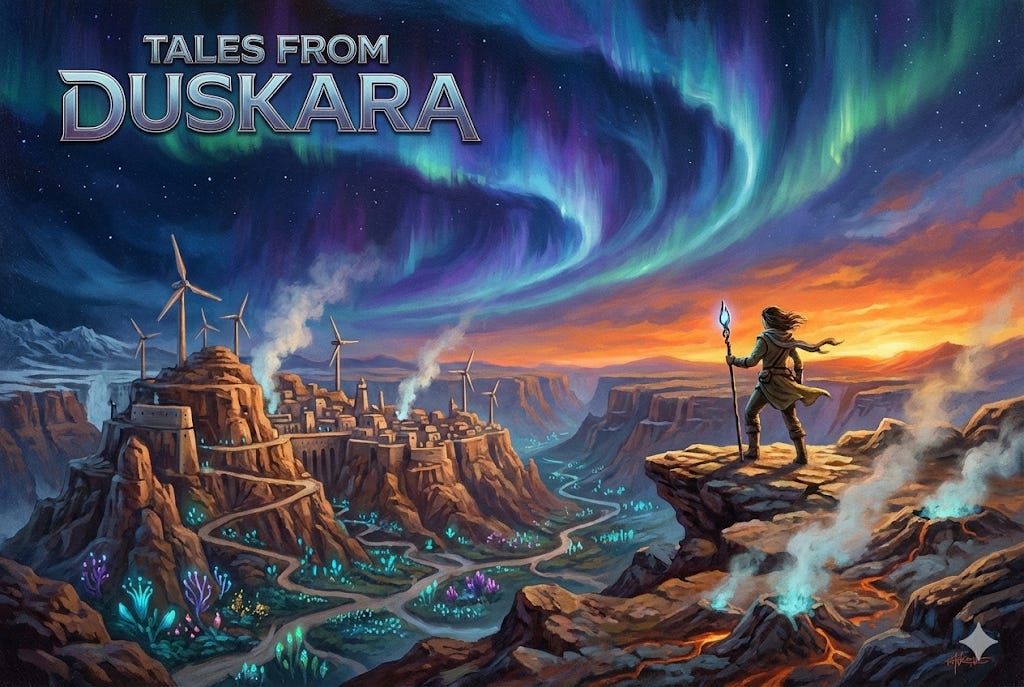
10. Arrival at Aetherion
The towers of Aetherion rose from Lake Auran’s shores like wind-carved monuments, tiered structures of wind-hardened stone and salvaged Stellar Horizon materials that caught the twilight’s amber glow and refracted it in bands of copper and ash. The Wind Caravan Accord approached from the northeast as the central twilight zone’s steady winds shifted toward the cooler evening phase, carrying the scent of cultivated glowcaps and the mineral tang of processed water from the city’s extensive purification systems.
Kael stood at the caravan’s head beside Vess, both of them reading the settlement ahead with the practiced assessment of those who understood that arrival was never simple homecoming but rather negotiation between what had been left and what remained. Behind them, thirty-two people moved with the careful efficiency of travelers who had learned their rhythms through crisis, cargo secured for final approach, water containers checked one last time, psychic practitioners sensing the city’s atmospheric signatures to confirm safe entry conditions.
Arden walked without assistance now, though Denna remained close, both weatherworkers reading the wind patterns that flowed around Aetherion’s carefully engineered windbreaks. The city’s defensive architecture channeled gusts safely around habitation zones while harnessing their energy through extensive turbine networks that powered the settlement’s geothermal regulators and vertical farming towers. It was technological synthesis made visible, Earth knowledge preserved through eight centuries meeting Duskaran adaptation, creating something that belonged to neither origin but functioned for both.
“Send the approach signal” Kael said to Mara, who carried the wind-flute used for formal communication with settlement watchtowers.
The mechanic lifted the instrument, its tones carrying across the lake’s surface with the particular harmonics that identified their caravan’s origin and intent. Three ascending notes, peaceful approach. Two descending, request for council audience. Then silence, waiting for response.
The answer came quickly: three ascending tones echoed back, followed by a single sustained note, approval granted, proceed to central market. Relief rippled through the caravan, visible in the way shoulders relaxed, in quiet murmurs exchanged between people who had carried uncertainty for too long.
Saryna appeared at Kael’s side, her pale Deepkin features showing the exhaustion that still marked her despite days of surface travel. “They’ll ask why cave-dweller travels surface.” she said, her voice carrying the flat pragmatism he’d learned to recognize as care disguised as observation. “Prepare answer. Surface people distrust depth-adapted.”
“The answer’s simple” Kael said. “You earned place through service to the collective. That’s the only credential that matters on Duskara.”
Saryna’s mouth quirked, that almost-smile that never quite formed. “Surface-dwellers say. Believing when person looks like me? Different question. Words run warm, actions run cold.”
“Then we make them believe it” Mara said, joining the conversation with characteristic directness. “You optimized machinery that kept sixty people alive. You used void attunement to stabilize a weatherworker on the edge of Wraith formation. Anyone questions your credentials, they answer to the entire Accord.”
The protective edge in Mara’s voice surprised no one, the mechanic’s integration of Saryna into her personal circle of trusted collaborators had been gradual but complete. They worked together with the practiced efficiency of people who had learned each other’s methodologies through shared crisis.
Aetherion’s central market spread across three terraced levels, each one carved into the hillside above Lake Auran with channels that allowed water to flow through every tier, creating both irrigation for the market’s gardens and symbolic connection to the city’s most precious resource. Traders from across the twilight belt maintained stalls here, textiles from Zephyrvale, preserved food from the northern settlements, rare minerals extracted from day-side mining operations. The mingled scents of spices, glowcap cakes, and geothermal minerals created atmosphere that spoke of civilization maintaining itself against planetary indifference.
The Wind Caravan Accord drew attention immediately. Not hostile, but curious, the mixing of people from what had been two separate caravans, the presence of a Deepkin traveling openly with surface-dwellers, the salvaged cargo that bore marks of storm damage and desperate repair. Kael watched traders assess them with the practiced evaluation of those who made living reading subtle signs.
An official delegation approached, three people wearing the formal wraps that indicated Council representation, their wind-tokens marking them as authorized speakers for Aetherion’s governance structure. The eldest, a woman whose weathered face showed decades of route-running before administrative service, stepped forward with the careful formality ritual demanded.
“I am Councilor Thess of the Wind-Kin Aetherion” she said, her voice carrying across the market without strain. “We received word that Kael kin-Hanga Thornvale’s caravan was overdue. We feared you lost to the superstorm.”
“Not lost” Kael replied, using the response formula that acknowledged survival without minimizing cost. “Transformed. We request council audience to report what transpired and renegotiate delivery terms.”
Councilor Thess’s gaze tracked across the Accord members, pausing on Saryna with visible recognition of her Deepkin features, then moving to the salvaged cargo, five crates of geothermal crystals where twenty-three had departed. “The Assembly convenes at evening meditation” she said. “You’ll have full hearing. Meanwhile, your people need rest and medical assessment.”
“We’re grateful” Kael said, and the word carried weight beyond politeness. Gratitude for shelter. For recognition that they had tried. For acknowledgment that failure and survival could coexist without contradiction.
The delegation led them through Aetherion’s streets, wind-carved pathways that spiraled upward through the settlement’s terraced levels, past vertical farming towers where wind-pollinated crops grew in carefully engineered microclimates. Children watched from doorways, their faces showing the mixture of curiosity and wariness that marked all encounters with outsiders. Elders made warding gestures, not hostile, but protective, asking ancestors to ensure these travelers brought no ill fortune to their settlement.
They were housed in a communal building near Lake Auran’s edge, a structure that had served travelers for generations, its walls showing the careful repairs characteristic of Duskaran philosophy, nothing wasted, everything maintained to serve future guests as well as current ones. Water was provided with appropriate ceremony: a single precious liter per person, drawn from the city’s carefully managed reserves and offered with murmured blessings.
The Council Assembly met in a circular chamber built around a wind focal point where three air currents converged, creating natural acoustics that carried voices without amplification. Representatives from Aetherion’s major guilds occupied the outer circle, resource managers, weatherworking specialists, trade coordinators, and psychic practitioners whose abilities served communal needs. At the center sat the Council of Windkeepers, five individuals elected to facilitate rather than rule, their role defined by guiding consensus rather than imposing decisions.
Kael stood at the circle’s threshold with Mara and Vess flanking him, the three of them representing the Wind Caravan Accord not as hierarchy but as voices selected through communal agreement. Behind them, other Accord members filled the gallery, Arden and Denna, Saryna, traders and handlers whose experience would inform whatever negotiations followed.
Councilor Thess opened proceedings with ritual water offering, pouring a single drop onto the stone floor at the focal point. “We gather to hear testimony about the superstorm that struck the central belt seventeen days ago” she said, her voice carrying the cadence of formal address. “And to determine appropriate response to changed circumstances.”
Kael spoke first, laying out sequence of events without embellishment: the decision to cross the Flats despite early warnings, Arden’s collapse and the psychic cost of weatherworking, the merger with Taror’s caravan in the shelter cave, Iven’s sacrifice during the flooding. He made no excuses. Didn’t frame survival as triumph. Simply documented what had occurred and acknowledged the cost, both in lives lost and cargo abandoned.
When he finished, silence held for several breaths. Then questions began, not hostile but seeking understanding.
“The geothermal crystals were meant for Harmattan’s Reach” a guild representative said. “Five crates represent less than quarter of the delivery. How do you propose we fulfill the contract? “
Mara stepped forward, her mechanical arm clicking softly as she gestured toward documentation she’d prepared during the journey. “Partial delivery with full transparency about the shortfall” she said. “The five crates we salvaged maintain full thermal capacity, no damage to their regulation properties. We propose delivering them immediately with accompanying documentation about the superstorm’s impact, allowing Harmattan’s Reach to determine whether partial supply meets their minimum needs. If not, we negotiate extended timeline for replacement cargo from next harvest cycle.”
“That leaves families facing cold wind phase without proper heating” another councilor pointed out.
“It does” Kael agreed, not minimizing the consequence. “But the alternative, claiming we can deliver what we don’t have, creates worse outcome. Transparency allows Harmattan’s Reach to seek supplemental supplies from other sources if our partial delivery proves insufficient.”
The practical logic was sound, and several councilors nodded acknowledgment. But another question followed, this one carrying different weight.
“You merged with a separate caravan during crisis” Councilor Thess said. “Then formalized that merger as permanent structure, the Wind Caravan Accord. This creates precedent. Other caravans may seek similar arrangements. How do we ensure such structures serve collective needs rather than accumulating power? “
Vess responded, his elder status lending authority to words shaped by generations of route-running. “The Accord operates through distributed decision-making” he said. “No single leader commands. We vote on major choices using wind urns. Resources are pooled and allocated based on communal need. We submit to the same oversight any caravan accepts, guild audits, settlement inspections, adherence to trade protocols. The structure isn’t power consolidation. It’s survival adaptation.”
“And the Deepkin who travels with you?” another councilor asked, the question carrying caution rather than hostility. “Saryna Vael. Her presence represents unusual integration.”
Saryna rose from the gallery, moving to stand beside Kael with the fluid grace characteristic of cave-dwellers. When she spoke, her voice carried the flat precision that marked Deepkin speech. “I violated enclave protocol. Used void attunement for surface-dwellers. That choice bars return. Permanent exile. The Accord offered place, service-based, not origin-based. I accepted. Their communal structure matches what my people say, not what they do. Words warm, practice cold.”
The honesty in her assessment, acknowledging Deepkin cultural limitations alongside surface-dweller acceptance, created visible impact. Several councilors exchanged glances, reading implications that went beyond this single case.
“If we recognize the Accord’s legitimacy” Councilor Thess said slowly”we establish precedent for other merged structures. For Deepkin integration into surface society. For permanent changes to how caravans function across the twilight belt. These are significant shifts.”
“They are” Kael agreed. “But the superstorm created conditions where traditional structures failed. Separate caravans would have died. Individual heroism would have killed the heroes. We survived through distributed effort and collaborative adaptation. Duskara doesn’t care about our precedents. It only cares whether we persist.”
The truth of that statement resonated through the chamber, visible in subtle shifts of posture, in hands moving to wind-tokens, in elders nodding recognition of what they’d learned through their own decades of survival.
The Council deliberated briefly, voices conferring in low tones, weighing practical concerns against philosophical implications. When Councilor Thess spoke again, her words carried formal weight.
“The Council recognizes the Wind Caravan Accord as legitimate structure” she said. “Subject to standard oversight and regular audits. We approve partial delivery to Harmattan’s Reach with documented explanation of shortfall. And we acknowledge Saryna Vael’s integration based on demonstrated service. These decisions will be recorded and shared with the Duskaran Accord Assembly when they next convene.”
Relief and something deeper, validation, perhaps, rippled through the Accord members in the gallery. Not triumph. They had lost too much for triumph. But acknowledgment that their choices had meaning, that survival through adaptation counted as success by the only metrics that mattered on this planet.
That evening, the Accord gathered at one of Aetherion’s wind focal points, a natural amphitheater carved into the hillside overlooking Lake Auran, where three wind currents converged to create harmonics that rang like distant bells. The ritual wasn’t mandated by the Council, but rather chosen by the Accord members themselves as way to mark transition from crisis to whatever came next.
Lira, who had offered the first water-blessings in the caves, stood at the focal point’s center with wind-charms crafted during their journey. She called names, starting with Iven kin-Hanga Kelthar. Carr, the blacksmith’s apprentice, placed his master’s hammer-and-anvil token at the focal point, and the gesture was echoed by others, small offerings for those who hadn’t survived, objects touched by hands now stilled but remembered through communal acknowledgment.
When the mourning concluded, someone began singing, a wind-song about travelers who had walked the first routes and learned that survival meant choosing persistence over certainty. Voices joined in layers, harmonies mixing Duskaran traditions with the new hybrid culture the Accord had developed through shared experience.
Kael stood at the amphitheater’s edge with Taror’s wind-charm in his hand, the former rival leader had given it during their separation, asking that Kael place it at Aetherion’s focal point to honor the alliance that had kept both groups alive. He laid it among the other tokens, acknowledging debt that transcended individual survival.
Beside him, Mara worked on her mechanical arm, making adjustments that would serve future needs rather than just current repairs. Saryna stood near the amphitheater’s edge, her reflective eyes tracking the thermal signatures of the gathering, and when Kael caught her gaze she nodded once, acknowledgment that surface-dwellers could, sometimes, maintain what they built rather than reverting to territorial competition.
Arden sat in meditation posture with Denna and Jeth, the three weatherworkers reading wind patterns with senses that had been broken and reformed, learning collaborative technique that distributed psychic cost across multiple practitioners. Their work would shape how future caravans approached atmospheric reading, not individual heroism but communal effort, safer and more sustainable.
The wind continued its work, carrying sound and scent across Aetherion’s terraced levels, and overhead the twilight sky showed faint auroral activity beginning to build, charged particles creating curtains of copper and violet light that would intensify over the coming days. The display was beautiful and indifferent, reminder that Duskara continued its planetary rhythms regardless of human struggle or success.
Tomorrow they would begin preparations for the journey to Harmattan’s Reach, carrying partial cargo and negotiating modified terms. The mission had transformed, like everything else the superstorm had touched, but it continued, not abandoned, merely adapted to changed circumstances. After that, the Accord would establish regular routes connecting settlements across the twilight belt, building infrastructure through careful accumulation rather than dramatic gestures.
Not triumph. Not certainty. Just persistence, measured in continued breath and distributed effort and the willingness to choose collaboration even when easier paths presented themselves. That was enough. On Duskara, it had to be.
The ceremony concluded as evening meditation shifted toward rest period, people dispersing to their temporary quarters with the quiet efficiency of those who had learned to conserve energy for tomorrow’s necessities. But they moved together rather than separately, the boundaries between original caravans fully dissolved now, replaced by the fragile unity they had built through crisis and maintained through choice.
Kael remained at the focal point after others departed, letting the wind’s harmonics wash over him, feeling the weight of decisions made and costs paid settle into memory rather than immediate burden. He had led them here, not through heroic action but through facilitating choices that proved sustainable. That was the lesson Duskara taught: individual brilliance meant nothing without collective support, and survival required adaptation rather than mastery.
The planet would continue reshaping itself according to forces no human could control. The storms would return, resources would remain scarce, and crisis would test whatever structures they built. But they had learned something the superstorm couldn’t erase: that collaboration yielded better outcomes than competition, that distributed effort was safer than concentrated heroism, and that persistence mattered more than perfection.
The wind carried these truths outward, dispersing them across the twilight belt where other caravans traveled, other settlements negotiated survival, other people learned the same lessons through their own struggles. Nothing was permanent. Everything adapted. And in the space between comfort and catastrophe, humanity on Duskara continued its work, not conquering, not even thriving, but persisting with the stubborn patience of those who understood that endurance was its own form of victory.
11. Taking The Path Again
The Wind Caravan Accord departed Aetherion three days after the Council’s formal recognition, thirty-two people moving with the practiced efficiency of travelers who had learned their rhythms through crisis and maintained them through choice. The twilight stretched before them, amber light refracting through atmospheric dust still settling from the superstorm’s passage, creating bands of copper and violet across the horizon that marked the planet’s constant state of transformation.
Kael walked near the caravan’s head beside Vess and Mara, the three of them navigating terrain reshaped by forces beyond human control. New wind patterns required constant adjustment, geothermal vents released steam where the storm had created fissures deep enough to reach heat sources, and the familiar landmarks of previous routes had been buried or exposed in ways that made every journey an exercise in adaptation.
Behind them, the five salvaged geothermal crystal crates moved on carefully maintained carts, their amber surfaces catching light like fragments of captured fire. The cargo represented partial success, not the triumph of complete delivery, but the persistence of attempting what could be managed despite what had been lost. Tomorrow they would reach the waystation where routes diverged toward Harmattan’s Reach, and there the negotiation would continue: explaining shortfalls, renegotiating terms, documenting the superstorm’s impact so future caravans could learn from their experience.
Saryna moved through the caravan’s middle section, her pale Deepkin features still drawing occasional glances from those unaccustomed to cave-dwellers traveling openly with surface groups. But the wariness had shifted, not disappeared, but transformed into something closer to curiosity, to recognition that difference could coexist with contribution. She paused beside a thermal vent, placing her hand flat against stone, reading the heat signatures that spoke of aquifer lines beneath the surface.
“Water here” she said to Torven, the water-finder who had become her primary collaborator in mapping underground resources. “Maybe thirty meters down, stable flow. Worth marking for future caravans.”
Torven knelt beside the vent, his own psychic senses confirming what her thermal reading had identified. Together they placed a cairn, stones arranged in the pattern that indicated water access, blessed with brief murmurs asking ancestors to guide future travelers to this resource. The collaboration was both practical and symbolic, distributed effort between different psychic abilities creating better outcomes than either could achieve alone.
Arden walked without assistance now, his weatherworker’s sensitivity gradually returning after the dampening field’s dissolution. Denna remained close, not from necessity but from the partnership they’d developed, two practitioners who had learned collaborative technique through shared crisis and now practiced it as preference rather than emergency measure. When they paused for rest, both settled into meditation posture at a wind focal point where three currents converged, their hands moving through atmospheric reading spirals in synchronized rhythm.
“The pressure patterns are stabilizing” Arden said after several minutes of concentrated sensing. “Stable wind phase should hold for at least another ten days. Good conditions for the Harmattan’s Reach delivery.”
Mara approached with repair supplies, canvas for torn equipment, wire salvaged from abandoned wagons, tools that had been redistributed through careful negotiation to ensure the Accord maintained capacity for ongoing maintenance. She settled beside her mechanical arm’s components, making adjustments that would serve future needs rather than just addressing current damage. The work was meditative, precise, and when Carr, Iven’s apprentice, joined her to learn technique, she taught with the same patient care the blacksmith had once shown.
“He would have liked this” Carr said quietly, his hands following Mara’s demonstration of how to tension replacement springs. “Building things that last beyond us.”
“That’s the only kind of building that matters” Mara replied, her voice lacking its usual sarcasm. “Temporary fixes just delay problems. Iven understood that, everything he made was meant to serve whoever came after.”
The conversation continued in this vein, practical instruction woven with grief and acknowledgment, teaching becoming memorial. Others gathered to watch and learn, the impromptu workshop creating space for skill transmission that transcended individual loss.
That evening, they made camp at a fractured ridge that offered windbreak, its stone surfaces showing fresh scars from the superstorm but its fundamental structure intact. Someone found glowcaps growing near a sheltered crevice, and these were carefully harvested, not depleted, but taken with the regenerative practice that ensured future travelers would find resources as well. The fungi were prepared as evening meal, shared communally with portions allocated by negotiated fairness.
As twilight deepened toward the cooler hours that approximated night in the belt, people gathered around a small fire built from storm-salvaged wood. The flames were low, conserving fuel, but sufficient for the ritual that had become evening practice since their emergence from the caves.
Kael held Iven’s hammer-and-anvil token, the small sacred object worn smooth by years of the blacksmith’s handling. He didn’t raise it dramatically or speak with performative grief, but simply placed it at the fire’s edge where everyone could see.
“We carry what those who walked before us gave” Kael said, his voice quiet but carrying across the gathered circle. “Iven gave us time when the water came. Gave us the structure that held long enough for others to climb. That gift continues, every repair we make with techniques he taught, every support beam we brace using principles he demonstrated.”
Saryna stepped forward, placing a smooth stone still faintly warm from geothermal heat beside the token. “In the caves, we honor the fallen by maintaining what they built” she said, her Deepkin accent rendering the words with particular cadence. “Iven’s work continues in the shelters we find, the machinery we repair, the knowledge we share. His echo moves forward with us.”
Mara knelt, placing a coil of wire beside the other offerings, components from her mechanical arm that Iven had once helped her install. “He fixed what was broken” she said simply. “Not just equipment. People too.”
Others followed, each adding small objects that carried personal meaning. Carr placed a nail bent at precise angle, his first successful metalwork under Iven’s instruction. Vess added a wind-token carved with protection symbols, murmuring blessings about ancestors recognizing service to the collective. A child offered a painted pebble, her small hands careful as she placed it among the other tributes.
When everyone had contributed, the collection shimmered in firelight, not wealth, but memory made tangible. The offerings would remain here, marked with a cairn so future travelers would know this was a place where someone had been honored. Other caravans would add their own tokens over time, and the memorial would grow through distributed contribution rather than single monument.
“He walks ahead” Kael said, using the traditional phrasing that acknowledged death without treating it as ending. “Like the twilight belt, present even when not visible, guiding the route we follow.”
The silence that followed wasn’t empty but full, respect and grief and belonging woven together through shared acknowledgment. Someone began humming a wind-song, wordless melody that others joined, creating harmonies that rose with the fire’s smoke toward the amber sky. The music wasn’t beautiful by technical standards, but it was theirs, shaped by their specific experience of loss and persistence.
Later, as the fire dimmed toward embers and most of the caravan settled into rest, Kael stood at the camp’s edge looking toward the horizon where their route continued. The landscape stretched endlessly, neither welcoming nor hostile, simply present, offering what it offered and demanding what it demanded. Tomorrow would bring new challenges, new negotiations, new adaptations required by circumstances beyond their control.
Saryna appeared beside him with the characteristic silence of cave-dweller movement, her reflective eyes tracking the thermal signatures of distant vents. For several breaths neither spoke, both watching the twilight’s gradual shift as atmospheric pressure changed with evening wind phases.
“You lead well” Saryna said finally, her voice carrying the flat honesty he’d learned to recognize as highest praise from Deepkin culture.
“I facilitate” Kael corrected gently. “The caravan leads itself through distributed choice. I just help organize the conversations.”
Saryna’s mouth quirked, that almost-smile. “Surface-dwellers have interesting ways of describing leadership without calling it that” she said. “In the caves we’re more direct, someone guides or they don’t. But I’m learning your methods have value. Slower, but more stable.”
“Will you miss the caves?” Kael asked, giving space for the question she’d been avoiding since their departure from Aetherion.
“Some aspects” Saryna said after considering. “The silence. The geothermal warmth. The certainty of knowing every passage. But safety can become another kind of trap, comfortable, yes, but limiting. After walking with you through the storm, returning to that kind of stillness felt like choosing death disguised as life.”
The honesty in her assessment, acknowledging both what she’d left and why, carried weight beyond the words. Kael understood the cost of her choice, the exile from enclave culture that came with using void attunement to help outsiders. She had paid for her place in the Accord not just through demonstrated skill but through irreversible transformation of her own belonging.
“The Accord benefits from your presence” Kael said, offering acknowledgment rather than platitude. “Not just your abilities. Your perspective, the way you see problems we’re too familiar with to question. That matters.”
“Then I suppose I should continue pointing out when you’re being fools” Saryna replied, humor threading through her pragmatism.
Kael’s rare laugh carried across the quiet camp. “Please do” he said. “We need that.”
They stood together in companionable silence, watching the twilight’s endless gradations, and when they returned to the fire’s dying light the camp felt less like temporary shelter and more like home being built through accumulated choices. Not permanent, nothing on Duskara was permanent. But present, functional, shaped by the people who had chosen to walk together rather than separately.
The wind continued its work, carrying their breath and the fire’s smoke across the landscape where other caravans traveled, other settlements negotiated survival, other people learned the same lessons through their own struggles. The superstorm had reshaped more than geography, it had demonstrated that collaboration yielded better outcomes than competition, that distributed effort was safer than concentrated heroism, that persistence mattered more than perfection.
Tomorrow they would continue toward Harmattan’s Reach, carrying what they could and adapting to what they couldn’t. The mission had transformed like everything the storm had touched, but it continued, not abandoned, merely adjusted to circumstances that would continue shifting as the planet pursued its own vast rhythms.
Above them, the twilight sky showed faint auroral activity building, charged particles creating curtains of copper and violet light that would intensify over the coming days. The display was beautiful and indifferent, reminder that Duskara continued its work regardless of human struggle or success, and survival required accepting that indifference rather than fighting it.
The Wind Caravan Accord settled into rest, thirty-two people breathing in synchronized rhythm, and if their dreams carried echoes of the storm and the flood and the losses that marked their journey, those echoes were woven now with something else: the knowledge that they had survived not through individual brilliance but through communal choice, and that made all the difference between despair and endurance.
Not triumph. Not certainty. Just persistence, measured in continued breath and distributed effort and the willingness to choose collaboration even when easier paths presented themselves. On Duskara, that was enough. It had to be.
12. The Path Forward
The Wind Caravan Accord stirred in the hour when twilight deepened toward what passed for night in the central belt, not darkness, but a shift in amber light toward copper, a cooling in wind temperature that marked circadian transition more through sensation than visibility. Harnesses creaked as people moved through morning preparations with the quiet efficiency of travelers who had learned their rhythms through crisis and maintained them through choice. Wagon wheels groaned under the weight of salvaged cargo, and the ground still showed moisture from the previous day’s rain, precious water that had already soaked into soil too deep for capture, leaving only glistening traces like memory of abundance.
Kael stood at the camp’s edge watching the caravan assemble itself through distributed effort, no one commanding, but everyone contributing to the collective task of preparing for another day’s journey. Below him, thirty-two people moved in patterns shaped by weeks of shared survival: Denna checking water containers with the reverence the resource deserved, Torven reading moisture patterns in the soil to determine the day’s optimal route, children helping adults secure cargo with the careful attention that came from understanding consequences.
Mara appeared beside him, her mechanical arm clicking softly as she made minor adjustments to its tension. “You’re reflecting again” she said, her voice carrying the dry edge that marked her characteristic speech.
“Someone has to” Kael replied, watching Carr, Iven’s apprentice, work on a wagon’s wheel assembly with the methodical precision the blacksmith had taught.
Mara followed his gaze, and her expression shifted, grief visible for a moment before pragmatism reasserted itself. “He’d have told you to stop dwelling and start moving” she said. She pulled something from her tool belt, a copper fastener worn smooth by years of use, one of Iven’s spare components, and tossed it into a passing cart where it would serve future repairs. “Forward’s the only direction that makes sense on Duskara.”
“Forward” Kael agreed, acknowledging both the word’s practical meaning and its deeper truth, that survival on this planet required persistence rather than arrival, adaptation rather than achievement.
Mara’s mouth quirked, almost a smile. She touched the wind-token at her belt briefly, a ritual gesture that had become habit, and moved back toward the caravan with her characteristic stride, shoulders square despite exhaustion that marked them all.
The Accord moved out as the wind phase shifted toward stable circulation, the atmospheric patterns that Arden and Denna had been monitoring through collaborative weatherworking indicating favorable conditions for travel. The landscape stretched before them in the perpetual half-light that defined the twilight belt, neither full visibility nor true darkness, but the in-between state where Duskaran life persisted. Scorched ridges marked where geothermal activity had intensified during the superstorm, and pools of water glinted in hollows where new aquifer access points had opened.
The terrain behind them showed the marks of their passage: wagon ruts carved into wind-hardened soil, cairns built to mark water sources for future travelers, scattered debris from equipment abandoned or destroyed during their journey. The path was ragged but undeniable, evidence that they had moved through this space and left it slightly changed, marked by human effort even as the planet continued its own vast work.
Saryna walked near the caravan’s middle section, her pale Deepkin features still drawing occasional glances but no longer with wariness, more with the curiosity that came from gradual integration. She paused at intervals to read thermal signatures, her void attunement sensing underground heat sources that might indicate shelter locations for future caravans. When she found something significant, she marked it with stones arranged in patterns that combined surface-dweller and cave-dweller symbols, cultural synthesis made physical.
“Water here” she called to Torven, gesturing toward a depression where thermal readings indicated aquifer proximity. “Thirty meters down, stable temperature. Worth documenting.”
The water-finder joined her, his psychic senses confirming what her thermal reading had identified, and together they built a cairn, practical infrastructure that would serve strangers they’d never meet, the Duskaran ethic of regeneration practiced through accumulated small acts.
As the caravan crested a rise, the full expanse of the route ahead became visible, rolling terrain that would take days to cross, settlements distant enough to seem abstract, the horizon smeared in light that never quite resolved into clarity. Kael paused at the ridge’s peak, letting others pass while he took in the landscape that would shape their immediate future.
Behind him stretched the evidence of where they’d been: the furrowed line of their march, boot prints and wagon tracks marking progress measured in meters rather than victories. Before him lay uncertainty, not threat exactly, but the constant unknown that characterized existence on a planet where stability was temporary and adaptation was the only sustainable response.
The storm had broken many things. Cargo, equipment, the certainty of familiar routes, lives that couldn’t be recovered or replaced. But in breaking, it had revealed what remained: not perfection, not even comfort, but the capacity to persist through distributed effort and communal choice. Like the twilight belt itself, neither day nor night but something that held between, neither conquered nor abandoned but continuously inhabited through patient adaptation.
A shaft of light broke through the cloud layer overhead, catching on a piece of abandoned equipment, a broken wheel hub that glinted like beacon in the half-light. The moment was brief, the light shifting almost immediately as atmospheric conditions changed, but it lingered in perception: nothing dramatic, nothing that solved problems or answered questions, just evidence that the planet continued its work and humans moved through that work rather than controlling it.
Arden appeared beside Kael, the weatherworker moving with the careful deliberation of someone whose psychic senses had been broken and reformed. “The pressure patterns are stable” he said, his voice carrying the quiet authority of recovered expertise. “Good conditions for the next few days. We should reach the waystation without significant atmospheric complications.”
“Should” Kael repeated, acknowledging the uncertainty embedded in any prediction on Duskara.
“Should” Arden agreed, his mouth quirking with humor that hadn’t existed before his collapse, something earned through survival rather than given. “But we’re reading collaboratively now. Denna and Jeth and I. If patterns shift, we’ll sense it earlier, respond more effectively. Distributed weatherworking works better than individual heroics ever did.”
The truth of that statement extended beyond atmospheric reading. Everything they’d learned through the superstorm pointed toward the same conclusion: that communal effort yielded better outcomes than concentrated brilliance, that distributed cost was safer than individual sacrifice, that persistence mattered more than perfection.
“We’ll need to establish formal protocols” Kael said, thinking ahead to the conversations they’d have with settlements along their route. “Document the collaborative techniques. Train other caravans in distributed psychic work. What we learned can’t stay with us alone.”
“Duskaran philosophy” Arden observed. “Make it better, share what you learn, leave infrastructure for those who come after. Iven would have appreciated that.”
They stood together in companionable silence, watching the caravan move through the landscape below, thirty-two people who had become something other than what either original group had been, shaped by crisis into structure that chose to persist beyond immediate necessity. Not perfection. The conflicts hadn’t disappeared, resources remained scarce, and the planet would continue creating challenges no preparation could fully address. But they had learned something the superstorm couldn’t erase: that collaboration was survivable, that adaptation was possible, and that meaning existed in the space between comfort and catastrophe where Duskaran life must always dwell.
“Let’s move” Kael said, using the phrase that had become ritual rather than command. Not dramatic. Not triumphant. Just acknowledgment that forward remained the only direction worth pursuing.
They descended to rejoin the caravan, and the Wind Caravan Accord continued its journey through the twilight that never quite gave way but also never gave out. The path ahead was broken in places, reshaped by planetary forces, uncertain in ways that required constant navigation. But it was there, not guaranteed, not comfortable, but present and traversable through the patient work of people who understood that endurance was its own form of victory.
Above them, the amber sky showed faint auroral activity beginning to build, and the wind carried the scent of geothermal minerals and distant water, and somewhere ahead the next settlement waited with its own challenges and possibilities. The crystals they carried would arrive diminished but functional, the mission transformed but not abandoned, and the conversations they would have about alliance and cooperation would shape routes beyond their immediate future.
Not triumph. Not certainty. Just persistence, measured in continued breath and distributed effort and the willingness to choose collaboration even when easier paths presented themselves. On Duskara, in the twilight that defined both planet and survival philosophy, that was enough. It had to be.