


Introduction
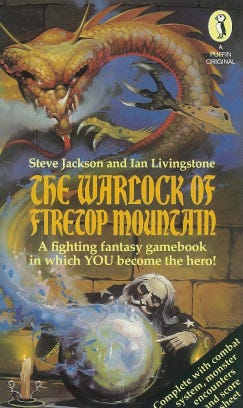
The Warlock of Firetop Mountain, the book that launched the Fighting Fantasy line in 1982, is remembered today as a genre-founding text: the first mass-market gamebook to fuse the branching structure of Choose Your Own Adventure with the resolution mechanics of tabletop role-playing. It is also, on replay, a startlingly hostile piece of design. Its dungeon is not a simple corridor of binary choices but a genuinely non-linear space, full of loops, dead ends, and a small number of deliberate chokepoints that exist purely to keep the book’s branching structure printable. Its combat system, built on the Skill/Stamina/Luck triad, is statistically punishing even for a character rolled at or near the maximum. And its win condition, three specific keys found in three specific locations and carried to a final chest that will not open without them, cannot plausibly be discovered on a first attempt. The book does not merely tolerate failure; it requires it as a precondition of completion.
This essay takes as its starting point a set of observations made about exactly this text: that Firetop Mountain is built around mandatory trial-and-error, that its combat is more lethal than its reputation suggests, and, most interestingly, that despite anticipating repeated failure as a structural feature, the book and its contemporaries never formalized any mechanism for checkpointing progress. Every reader who has played these books, it turns out, independently invented the same workaround: keeping a finger wedged between pages, or maintaining a mental map of which forks lead to death, and restarting not from paragraph 1 but from whatever point they judge safe. This is a fascinating case of a design gap being silently patched by an entire generation of players using the same ad hoc technique, without the designers ever acknowledging or formalizing it. What follows is an attempt to unpack why that gap exists, what it reveals about the design culture of early gamebooks, and what it implies for anyone, myself included, in the context of RPG design work like Heroic Evoke, building punishing, exploration-based systems today.
Trial-and-error as the actual genre
It is worth being precise about what kind of failure Firetop Mountain traffics in. There are, broadly, two ways a branching narrative can punish the reader. The first is narrative failure: you make a choice, the story goes somewhere worse, but you are not ejected from the fiction: you simply experience a different, lesser outcome. The second is systemic failure: you die, or you reach the end without having satisfied a hidden condition, and the book tells you, in effect, that this playthrough does not count. Firetop Mountain is overwhelmingly the second kind. Wrong turns do not degrade the story; they end it. And because the win condition depends on collecting specific items scattered behind specific doors, “playing well” in the sense of making sensible in-fiction decisions is not sufficient to win. You can behave exactly as a sensible adventurer would, avoiding obviously dangerous rooms, retreating from unfavorable fights, husbanding resources, and still arrive at the vault without the third key, because nothing in the fiction told you that a particular closet, easily skippable, contained something essential.
This is the sense in which the golden path is undiscoverable on a first attempt: not merely difficult to find, but epistemically inaccessible. The information needed to route correctly through the dungeon is distributed across paragraphs the reader has, by definition, not yet read, and there is no in-fiction signal, no foreshadowing, no NPC hint reliably present on a blind run, that would let a first-time reader infer the correct sequence. The book is not testing tactical judgment so much as testing memory of a previous failed attempt. Structurally, this makes Firetop Mountain closer to a maze with a single correct solution overlaid on a combat gauntlet than to the “choose your own adventure” branching-story format the surface presentation suggests. The branches are real, and the prose response to each choice is often well-crafted and specific, but the game underneath is a memorization exercise disguised as an exploration narrative.
The combat system compounds this. The received wisdom about Fighting Fantasy, repeated often enough that it functions as folklore, is that a character rolled with maximum or near-maximum Skill can “walk through” the book, and that stories of narrow escapes or unexpected deaths are the result of poor play or bad luck rather than the system itself. Actual play does not bear this out. The 2d6-based attack roll compared against a fixed Skill score produces win probabilities that degrade sharply as the number of consecutive fights increases, and Firetop Mountain in particular stacks several fights back to back with limited opportunity to recover Stamina between them. A character with Skill 12 (the maximum) still loses individual combat rounds at a non-trivial rate, and Stamina, once spent, is not easily replenished mid-dungeon. Running a full campaign of the book, as opposed to a single isolated encounter, exposes how close to death a “well-built” character can come, repeatedly, even when played with full knowledge of the correct route. The claim that skill investment alone insulates a player from death is a comforting simplification that does not survive contact with the dice.
Why this matters for design, not just nostalgia
It would be easy to treat all of this as an artifact of an unsophisticated early design era, interesting only as history. But the trial-and-error structure of Firetop Mountain is load-bearing, not accidental sloppiness. A gamebook is a single physical object with a fixed number of paragraphs. It cannot dynamically adjust its difficulty, cannot present a hint system that reads the player’s history, cannot do anything a modern branching-narrative video game can do with save states and adaptive text. Within those constraints, requiring repeated attempts is one of the few ways to extend a book’s playable lifespan and to make a genuinely non-linear structure worth the printing cost of the wrong branches. If the correct path were discoverable on a first read, most of the book’s paragraph budget, the ones describing wrong turns, would be content nobody experiences on their winning run. Punishing exploration and demanding memorized replay is, in that light, a way of ensuring the reader consumes more of what was written. The difficulty is not merely thematic (dungeons are dangerous, so the book should be dangerous) but economic and structural: it is what makes non-linearity worth the paper.
This reframes the “why didn’t they include save points” question. It is not that Livingstone and Jackson failed to imagine a Souls-like checkpoint system and stumbled into trial-and-error by accident. It is closer to the reverse: trial-and-error was the design goal, and a formal checkpoint mechanic would have partially undermined it, by letting players resume from deep in the dungeon with full knowledge but without having to hold that knowledge themselves. The tension is between two different currencies of progress, player knowledge versus formalized bookkeeping, and the gamebook format, lacking any bookkeeping tool beyond a pencil and the reader’s own memory, defaults to the former. Every reader who kept a finger between pages was not circumventing the design; they were completing it. The “official” absence of a checkpoint mechanic and the near-universal, independently-reinvented presence of an unofficial one are two halves of the same system.
The Dark Souls comparison, and where it breaks down
The comparison to bonfires is illuminating precisely because it clarifies what a gamebook cannot do. A Souls-style checkpoint is a piece of world simulation. Enemies respawn, but the player’s build, equipment, and accumulated knowledge persist. Crucially, the game remembers things a gamebook physically cannot: which enemies you have already fought, which shortcuts you have unlocked, which items you have picked up, all without requiring you to hold that state in your own head or on a scrap of paper. A gamebook has none of this infrastructure. Every piece of persistent state, inventory, wounds, which doors are now known to be traps, has to be tracked manually by the reader on a character sheet, and the book itself has no way of “knowing” that you have been here before. A formal checkpoint system in a gamebook would therefore have to be something much cruder than a bonfire: probably a set of named paragraphs the reader is instructed to write down, functioning as bookmarks, from which they are told they may resume after death without penalty.
This is not technically difficult to design: the essay’s opening observation is correct that it is a strange omission, not an impossible one. A short table of “safe waypoints” tied to specific paragraph numbers, explicitly sanctioned by the rules text (”if you die, you may resume from the last waypoint you reached, retaining your equipment and any keys found, but starting combat-fresh”), would have cost almost nothing in production terms and would have removed the read-between-the-lines quality of the finger-in-the-pages technique. That nobody in the early Fighting Fantasy line formalized this, despite an entire readership converging on the same informal solution, says something about the design culture of the moment rather than about any technical constraint.
Three explanatory threads are worth separating here, because they are not equally strong.
The first is the “no available model” explanation: that gamebooks predate the video-game save state as a widely understood convention, so the designers had no genre precedent to draw from. This is only partially convincing. Save states existed in some early computer games by the early 1980s, and more importantly, gamebooks did not need to borrow from video games at all: a “you may resume from here” instruction is a purely textual convention, no more technically demanding than the branching structure itself. The absence of a cultural template explains why the idea might not have occurred to the designers unprompted, but it does not explain why nobody added it once the trial-and-error problem became obvious through actual play.
The second thread is the tabletop RPG inheritance: gamebooks descend directly from Dungeons & Dragons-style play, where character death is often final and the campaign continues with a new character rather than a rewound one. This explanation is stronger, because it identifies a genuine structural transplant. In a tabletop game, permanent character death is bearable because the table persists: the GM, the other players, the ongoing campaign world all continue regardless of any one character’s fate, and a new character can be woven into that continuity in ways that cost the group very little. A solo gamebook has no table to fall back on. There is only the reader and the book. Transplanting “character death is permanent, roll a new one” from a group activity into a solitary one removes the very thing that made the convention tolerable in its original context. The designers imported the rule without importing the social scaffolding that made the rule work, and the result is the “multiverse” absurdity correctly identified in the source material: a reader who has died six times, and is now on a seventh nominal protagonist, but who is functionally the same continuous agent, holding the same accumulated knowledge, simply wearing a new character sheet as a formality.
The third thread, the fear that an official checkpoint would make the book “feel” too easy or too short, is the most speculative but also the most design-relevant. If accurate, it suggests the designers were, consciously or not, using unnecessary friction as a proxy for value: a book that takes twenty attempts to complete feels like it contains more game than one that takes three, even if the actual authored content is identical either way. This is a design trap that persists well beyond gamebooks: the conflation of “time spent failing” with “value delivered” shows up constantly in modern game design discourse, usually under less flattering names. It is worth naming here because it is the one explanation that implicates the designers’ priorities rather than their tools or their genre inheritance, and it is the one most directly relevant to anyone building a punishing system today: length achieved through repetition is not the same thing as length achieved through content, and conflating the two produces exactly the kind of dissonance described below.
The metagame dissonance
The most interesting failure mode identified is not mechanical but experiential: the split between the player and the character produced by repeated death-and-restart. On a nominal narrative level, each new attempt is a new protagonist entering the dungeon for the first time, with no in-fiction memory of previous attempts. On the actual experiential level, the player piloting that new protagonist knows exactly which door leads to a giant spider and exactly which fork conceals the second key, because they died learning that on a previous run. The character is notionally naive; the player is not. This produces a strange puppetry effect, in which the fiction’s claim that “you have never been here before” is constantly and silently contradicted by the reader’s behavior, which is that of someone navigating from memorized notes.
Most branching-narrative media that involve failure and retry have to solve this problem somehow, and it is worth noting how differently other media have handled it, if only to sharpen what makes the gamebook case distinctive. A video game like Dark Souls solves it by not pretending the amnesia is total: your character explicitly retains memory, items, and levels across deaths, and the fiction is built around a curse of undeath that makes repeated dying part of the premise rather than a contradiction of it. A visual novel with a “true ending requires multiple playthroughs” structure often leans the other way, explicitly narrativizing the loop: the protagonist is looping through time, or the multiple playthroughs represent different timelines being compared by an outside observer. What both of these solutions share is that the fiction absorbs the metagame: the game finds an in-world justification for the fact that the player, not just the character, is accumulating knowledge across attempts.
Classic Fighting Fantasy gamebooks do neither. They offer no fictional frame for repeated attempts at all: no reincarnation myth, no “the mountain remembers your death and rearranges itself,” nothing. The rules text simply says: if you die, start again as a new adventurer. This leaves the dissonance fully exposed rather than absorbed, and it is precisely because nothing in the text acknowledges it that players had to solve it themselves, silently, through the finger-in-the-pages technique, a purely mechanical hack with no narrative justification offered or needed, because the book never asked for one.
Implications for design work in the same space
Anyone building an exploration-heavy, failure-punishing system today inherits this same design fork, whether the medium is a gamebook, a dungeon crawler, or a solo tabletop game built around procedural risk. Three implications seem to follow directly from the analysis above.
First, if a system is going to require trial-and-error as its actual mode of play, as opposed to trial-and-error being an unintended side effect of high lethality, that requirement should be stated honestly, in the rules text, rather than left implicit and discovered by the reader through repeated failure. A rules line that says, in effect, “you are expected to die and restart; here is how restarting works” costs nothing and removes an entire category of reader confusion about whether they are “playing it wrong.”
Second, the choice between narrative death-and-restart and a formal checkpoint mechanic is not a binary between “hardcore” and “casual” design; it is a choice about where the burden of continuity is placed. Placing it entirely on the reader’s memory (the classic gamebook approach) externalizes bookkeeping onto the player at the cost of producing exactly the character/player dissonance described above. Placing it in the system, even minimally, with a short list of sanctioned waypoints and a rule for what persists across a death, removes the dissonance without necessarily removing the difficulty. A punishing system does not need permadeath-with-total-narrative-amnesia to be punishing; the punishment can live in resource loss, position loss, or narrative complication at the checkpoint, rather than in the fiction of a wholly new, wholly ignorant protagonist.
Third, and most specifically to combat-heavy dungeon material in the Fighting Fantasy tradition: reputation is not evidence. The received wisdom that a maxed-out character trivializes the book is exactly the kind of folklore that survives because nobody actually plays the full campaign back to back and tracks the near-deaths. Designers working in this tradition, including in a rules-on-Fighting-Fantasy project like Heroic Evoke, inherit both the genre’s difficulty curve and its reputation for being easier than it is. Actual play data (or, absent that, actual full playthroughs, tracked honestly) is the only reliable check against inheriting the folklore along with the mechanics. If a system’s community consensus says “high Skill trivializes combat” and actual multi-fight sequences say otherwise, the system is being misjudged by its own players in a way that will eventually surface as unexpected frustration, exactly the frustration the original voice memo describes experiencing firsthand, running a Fighting Fantasy campaign and repeatedly coming close to a death the received wisdom said should not have been possible.
A closing observation
The most durable image from this whole discussion is not the dungeon, or the keys, or the spider: it is the finger wedged between two pages. An entire readership, working in total isolation from one another, arrived independently at the same unofficial patch for the same unacknowledged design gap, and it took decades of players comparing notes to discover that this was not an idiosyncratic cheat but a near-universal convergent solution. That convergence is itself the strongest possible evidence that the gap was real: when a large, disconnected population of users independently invents the identical workaround for a system, the system is missing a feature, not testing the users’ resolve. The interesting design lesson is not “gamebooks were too hard”: difficulty was clearly intentional and, in its own terms, well-motivated by the format’s constraints. Rather, the designers mistook the absence of an acknowledged solution for the absence of a problem, when in fact the problem was simply being solved silently, off the page, by every single reader, the same way, without being told to.