


I don’t usually promote crowdfunding campaigns, and I back even fewer. There are many reasons for this (some practical, some philosophical) that I’ve touched on before and will likely revisit. The noise-to-signal ratio is brutal, the pressure to perform enthusiasm exhausting, the risk of disappointment real.
But there are exceptions, as with all sensible things. These exceptions tend to be projects by designers whose work has genuinely shaped how I think about the medium. Graham Walmsley’s Cosmic Dark comes to mind.
This time, I won’t pretend I’m coming at this from pure critical distance. Barbabianca is designed by Cristian Sisto, a friend whose work I’ve watched develop over years. But I’m sharing this campaign primarily out of professional esteem, not sentiment. This is a game of absolute value, one I’m genuinely proud to have witnessed come into being, and it deserves attention beyond my personal circle.
Disclaimer: I have no financial or business affiliation with NessunDove or Cristian Sisto. I'm not receiving compensation for this recommendation, and I backed this project with my own money because I believe in the work.
What Barbabianca Actually Does
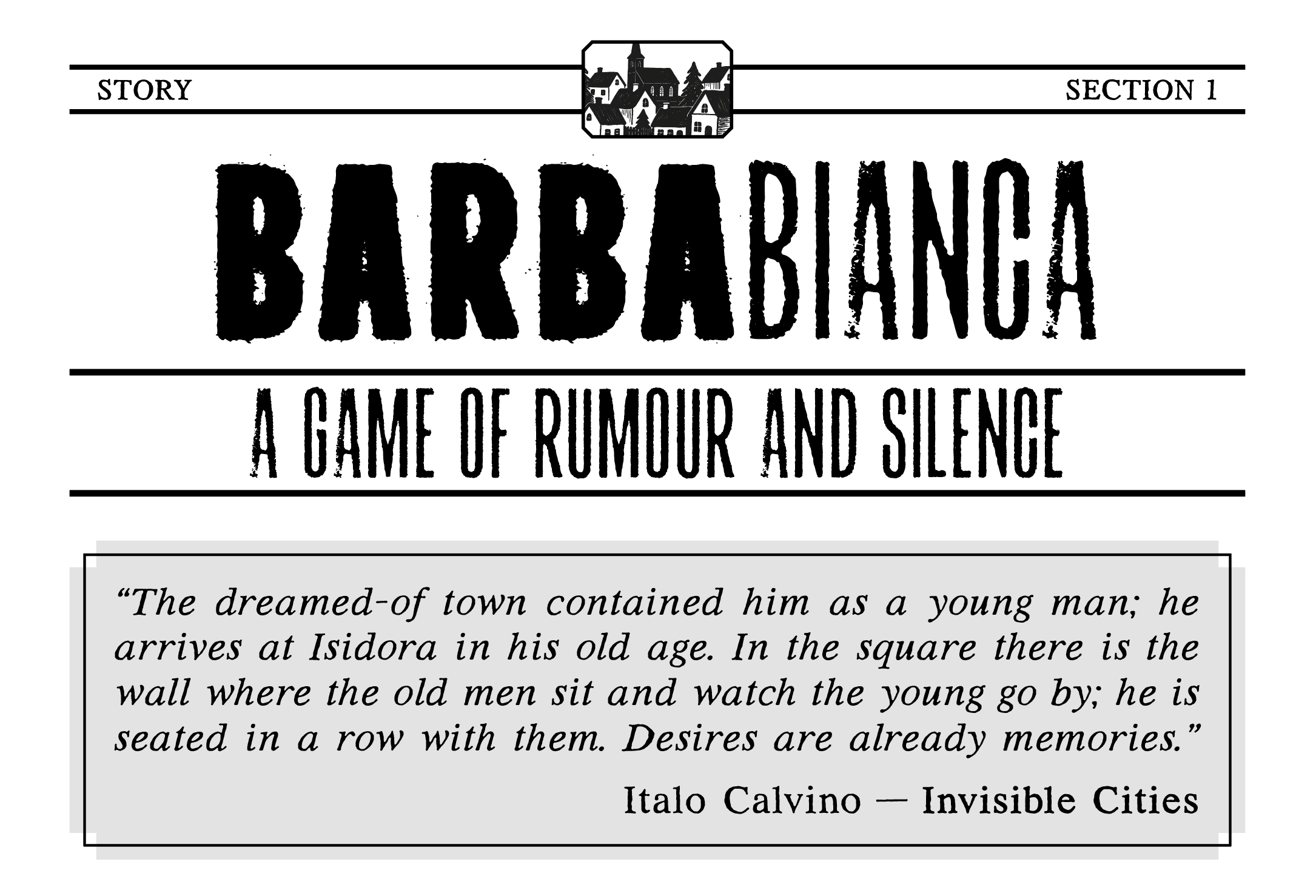
Barbabianca is a zero-prep collaborative storytelling game for 3-4 players set in rural Italy at the turn of the twentieth century. It draws explicitly from Italian anti-fascist literature (Calvino, Pavese) and neorealist cinema (Rossellini, De Sica) to tell a story about how hard times and easy answers destroy communities.
The mechanical structure is elegant and specific. You begin by choosing roles from a selection of village archetypes: the mayor, the innkeeper, the brigand, the curate. As you define these characters through question prompts, you’re simultaneously building the village itself: drawing key buildings onto a laminated map, establishing the emotional temperature of the community, tracing webs of relationships.
Then the story unfolds act by act through Events that reshape the game’s mechanics. Each Event introduces new narrative moves: Tales of daily village life, Memories of the mysterious Barbabianca, Rumors that twist and spread through the community, Secrets that threaten to unravel your character’s standing. The mechanics don’t just track story. They generate the social physics of gossip, shame, and collective memory.
The Moral Weight
What makes Barbabianca more than a well-crafted period piece is its ending structure. After an earthquake unearths a buried scandal, Barbabianca (the village’s marginal figure, the old man who lives beyond the circle of stone houses) becomes the target of mob justice. His guilt or innocence was determined secretly at the start, but that almost doesn’t matter. What matters is the choice the game gives you: spare him by revealing your own character’s secrets, letting your own life be ruined, or stay silent and watch the community burn its sins along with the truth.
This isn’t a thought experiment. It’s a mechanical demand that forces you to weigh complicity against safety, to feel the suffocating pressure of a community that needs someone to blame. The game asks you to understand how ordinary people become participants in atrocity, not through explicit malice, but through the small, self-preserving choices that add up to collective violence.
Format and Accessibility
The production format matters here too. Following the model NessunDove established with Our Queen Crumbles, this comes as a boxed set of laminated sheets you can write on with water-based markers and erase between plays. You write your secrets, seal Barbabianca’s fate, then wipe it clean and try to forget. The physicality of erasure (the ritual of making the game disappear) reinforces the themes of memory and shame that run through the design.
Everything you need is self-contained: complete rules readable in one session, the village map with spaces to fill, four acts of illustrated Events, up to twelve character roles. No prep, no supplementary purchases, no DM screen to hide behind.
Why This Matters
Solo and GMless design often gets pigeonholed as “storygames” or treated as a curiosity separate from the broader TTRPG ecosystem. But projects like Barbabianca demonstrate something crucial: these structures can carry serious thematic weight and historical consciousness. They can reckon with difficult questions about community, justice, and moral compromise in ways that feel immediate and personal, not abstract.
The campaign is running through February 27, 2026, as part of Zinetopia/Zine Month. They’re nearly ready to print, with delivery planned for May 2026. If you’re curious about games that use structure to create moral pressure, or interested in how regional history and political consciousness can inform RPG design, this is worth your attention and your support.