


Some worlds are born from narrative arcs. Marethar was born from a long-standing obsession with ancient civilizations—particularly those that flourished around the Mediterranean, and even more so, those of the Bronze Age.
I’ve always been fascinated by that strange, advanced-yet-foreign moment in human history. And I’m not new to engaging with it through design. Talassa explored its mythic shadow. Through the Ashes approached its collapse through a lens of survival and exploration. But Marethar comes from a different impulse.
It’s speculative. Not alternate history—but a kind of what if that doesn’t seek to reconstruct the past, but to extrapolate a new kind of fantasy from it. What if those Bronze Age cultures had evolved toward more complex technological horizons—not quite steampunk, but not static either? After all, the Hellenistic world brushed against the edges of the industrial revolution long before our own 19th-century version emerged.
That line of thought became a vehicle—not to create a "neocronia," but to imagine a fantasy setting that doesn’t borrow from Tolkien, D&D, or the usual suspects.
What It Is
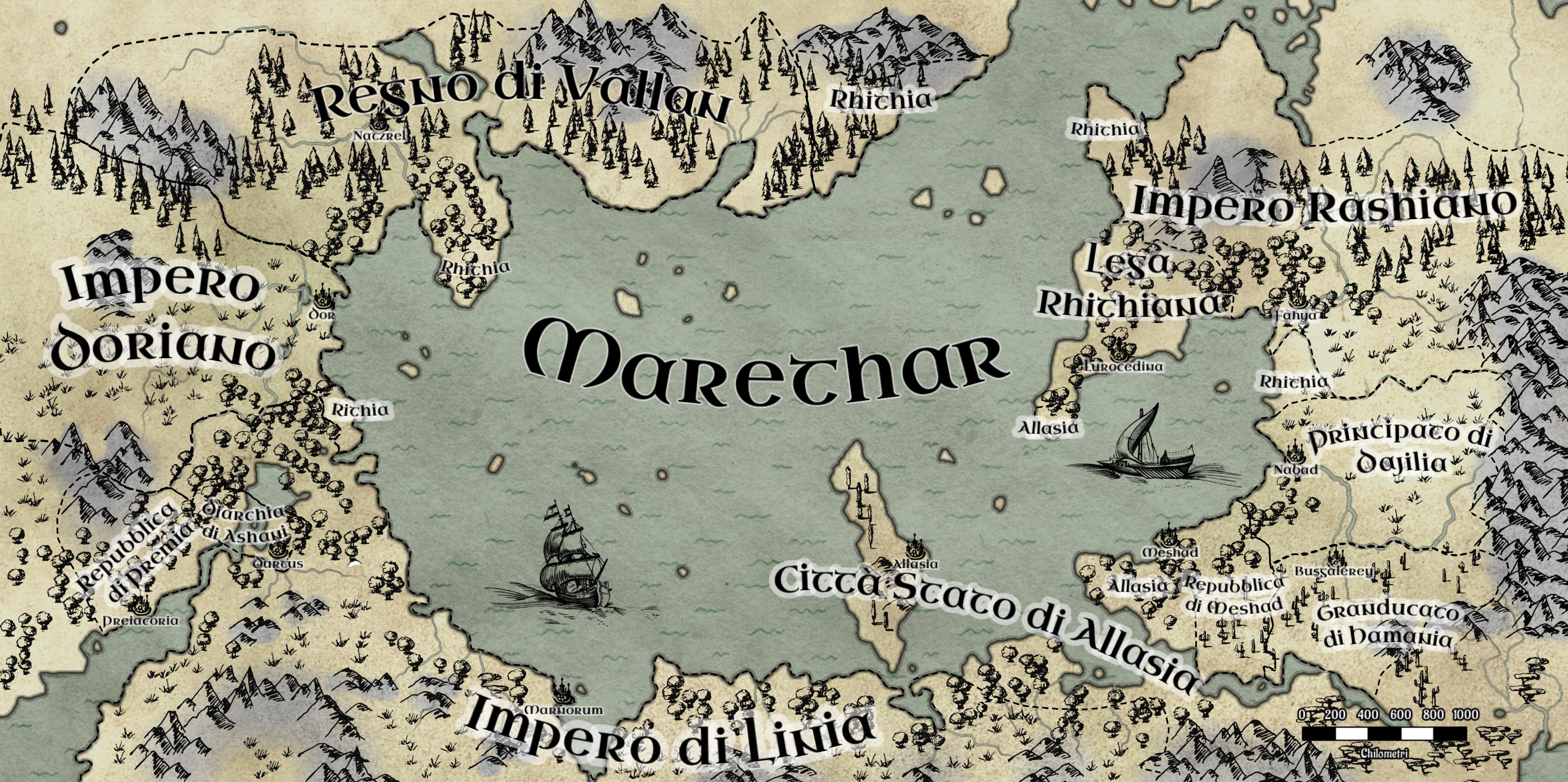
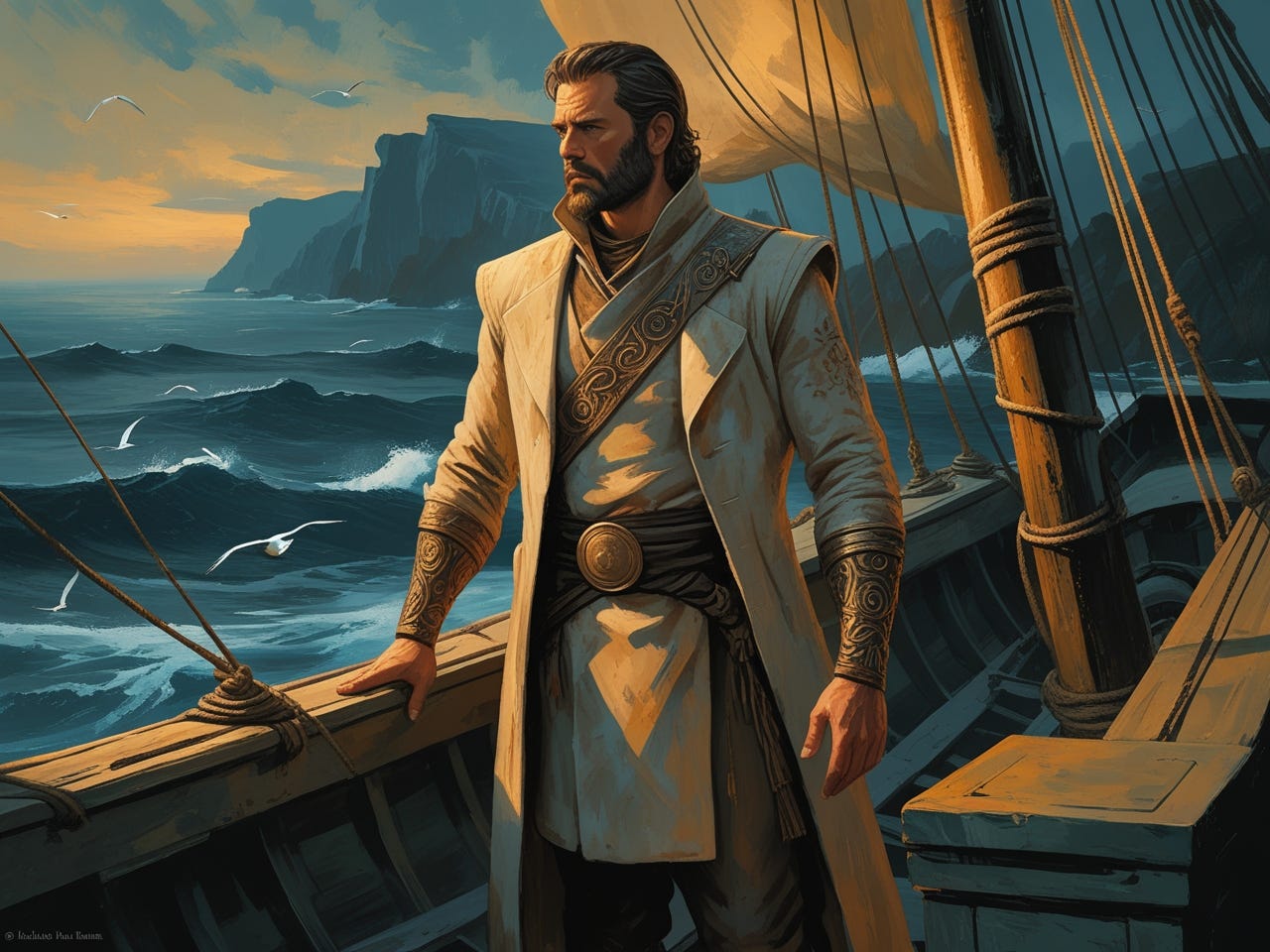
Marethar is a Gunpowder Med-Fantasy setting rooted in speculative history. Think of it as a fantastical reimagining of the Mediterranean basin, built around a vast inland sea and six major cultures. These civilizations evoke Bronze Age memory but are equipped with early modern technologies—cannons, printed maps, fortifications, even early science and alchemy.
It’s not the first time designers have mined the Bronze Age for inspiration—Glorantha famously draws from it—but I wanted a fantasy world that felt lived-in, fragmented, and credible without falling into dungeon tropes. Creatures exist, yes—but drawn from mythology and culture, not from encounter tables. Religion has teeth. Language is power. The sea is central.
Marethar is a collaborative project developed within Orizzonti GDR, and part of the larger Boundless Worlds initiative. It's released under a Creative Commons BY-SA license to encourage adaptation and reuse. While the worldbuilding was shaped by a collective process, I served as the main contributor and curator, guiding the historical synthesis, cultural abstraction, and overall vision of the setting.
This was never meant to be a completist atlas. Instead, Marethar is a fragmented fresco, a toolkit of tensions, tones, and scaffolding meant to be occupied by players, GMs, soloists, or even fiction writers. The setting offers no fixed canon—just the opportunity to inhabit complexity.
Design Principle #1: No Metaplot, Just Material
Marethar doesn’t hand you a plot. It hands you pressure points.
Every religion is divided.
Every culture is fractured.
Every region is unstable.
There are no story arcs to follow. No empires in decline you’re supposed to mourn. No official NPCs to protect. It’s a world in flux, meant to respond to your decisions, not guide them.
Perfect for:
emergent play,
sandbox campaigns,
OSR-style exploration with thematic weight.
Design Principle #2: Magic as Cultural Faultline
Magic exists—but not as a universal system. It’s ritual, religion, myth, and memory. There are four major approaches:
Elemental magic rooted in the natural world,
Divine magic mediated through priesthoods,
Shamanic magic passed orally and performed in trance,
Alchemical magic bound to materials, guilds, and codices.
Each form is culturally embedded and socially contested. What’s revered in one city is banned in another. What’s miraculous in one region is a hoax somewhere else.
Instead of spell lists, Marethar gives you political ambiguity, local doctrine, and arcane rumors. You don’t cast spells—you investigate what it means to do so.
Design Principle #3: Culture as System
The heart of the game isn’t mechanics—it’s culture.
Each civilization in Marethar:
speaks a different calendar,
negotiates with different gods,
traces different borders in ink or in blood.
These aren’t static monoliths. They evolve, contradict themselves, and remember different versions of the same event. The idea isn’t to catalog them, but to create a map of overlapping truths.
Your campaign might center on:
a diplomatic crisis between river cults and mountain ancestor-worship,
a banned festival re-emerging in a harbor city,
a senatorial vote that hinges on theological nuance.
Design Principle #4: Aesthetic Density
Visually, Marethar isn’t gritty or washed out. It’s ornate and contradictory.
Technology sits somewhere between the Renaissance and the Baroque.
Myth and ritual still shape social structure.
Cultures layer bronze-age symbolism onto gunpowder-era logistics.
Think:
sandstone citadels lit by oil-lamps,
processions of masked priests crossing salt flats,
heretical navigators drawing forbidden routes on vellum,
palaces echoing with censored songs.
You’re not exploring ruins. You’re living inside a tension that hasn’t decided what counts as real yet.
Practical Use
Marethar is written with modularity in mind. You can:
Use it as your primary setting.
Insert one of its cultures into your existing campaign world.
Rip pieces out for use as worldbuilding prompts.
It’s playable with any system. We’ve used it with freeform narrative games, lightweight OSR frameworks, and solo journaling rules. It doesn’t depend on stat blocks—it depends on understanding what a culture values and what it’s willing to trade away.
Why We Made It
Honestly? Because we wanted to play in a world that didn’t flatten the past.
We didn’t want another setting with elves and orcs, or another pantheon of vaguely Greek gods doling out blessings by alignment. We wanted a fantasy world that treats the Mediterranean as a living engine of conflict, trade, memory, and contradiction.
We wanted to imagine what Bronze Age cultures might have become, had they sidestepped our history and evolved toward something strange and beautiful.
And We wanted to give players a world that doesn’t ask them to solve it—just to inhabit it fully, and to make it theirs.
How the World of Marethar Took Shape
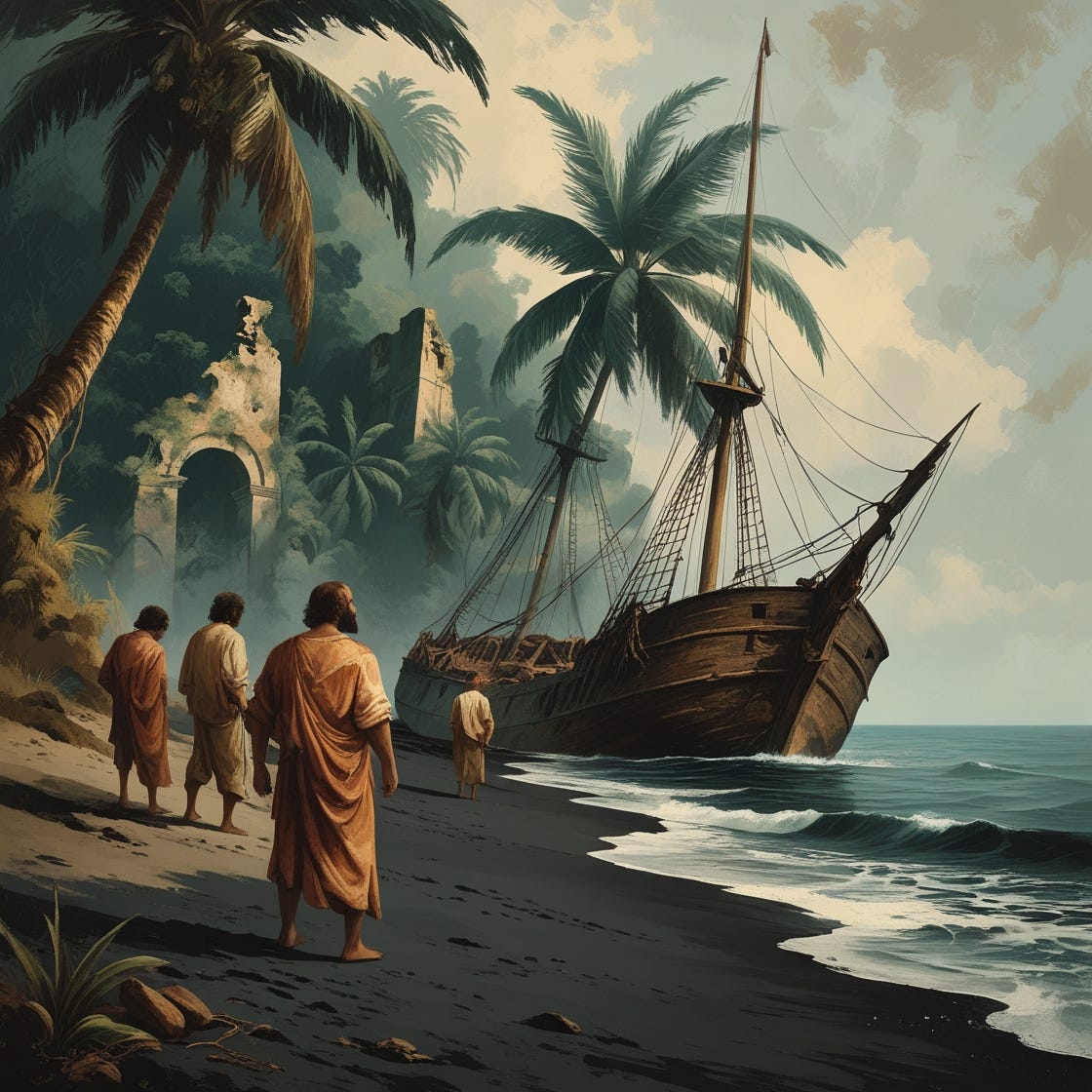
Marethar didn’t start with a narrative—it started with questions. What would happen if ancient cultures evolved toward complexity on their own terms? What if Bronze Age values shaped a Baroque-level society? What if geography wasn’t background, but engine?
Here’s how we built that world.
1. Six Cultures as Design Anchors
We grounded Marethar in six macro-cultures—not to reproduce them, but to abstract and reimagine:
Lysandrians draw from Greek maritime traditions and the logic of merchant city-states. They're astute navigators, traders, and coastal competitors bound by ritual sea festivals and economic rivalry.
Aurelians evoke the aesthetics and engineering grandeur of Roman and Hellenistic polities. They're culturally syncretic, with both imperial legacies and forest-based druidic roots.
Naharim echo the great riverine civilizations of the Nile and Mesopotamia. They're shaped by irrigation, ritual agriculture, and a theology embedded in seasonal floods.
Orethians channel highland isolationism and metallurgical expertise. They reflect the mythic weight of mountainous societies bound to ancestral pacts.
Aridonians evolve from desert and steppe nomads, preserving clan-based authority, ancestor veneration, and solar-ritual cycles. Their resilience is spiritual, architectural, and political.
Thalassians, are based on ancient Minoans blended with Venice Republic and synthesize multiple coastal legacies into a stratified naval aristocracy, deeply tied to trade and maritime prestige.
These weren’t analogues—they were lenses. We used them to build value systems, aesthetics, and contradictions.
2. Geography as Constraint, Not Canvas
Rather than draw a "cool" fantasy map, we used Azgaar’s Fantasy Map Generator to simulate elevation, river systems, climate, and wind patterns. This allowed us to ensure that:
Aridonian oases formed along believable fault lines.
Naharim cities arose at the confluence of river networks.
Lysandrian ports followed ocean currents and trade winds.
The goal was to let terrain dictate development—not the other way around.
3. Cultural Placement and Interplay
Once the terrain was in place, we layered cultures:
Lysandrians clustered along island chains and semi-independent coastal cities.
Naharim developed inland, where irrigation-based urban centers thrive near seasonal floodplains.
Aridonians spanned southern deserts and steppes, with cities-oasis forming along sacred routes.
Aurelians occupied temperate zones rich in forest and stone, blending agrarian innovation with urban sophistication.
Orethians settled in mineral-rich highlands with fortified settlements and sacred peaks.
Thalassians dominated strategic naval corridors, establishing social stratification through fleet control and mercantile wealth.
But instead of isolating each culture, we emphasized overlap—borderlands, enclaves, shared holy sites, old treaties, and conflicting myths.
4. Subversion Through Reversal
We deliberately reversed geographic expectations:
Naharim are west of center, not east—a conscious nod to reorient assumptions about river-based civilizations.
Aurelians, often assumed to be imperial, are more ritualistic and diverse—with both monumental states and forest-dwelling cults like the Druidi di Dimilalica.
Religions are built on cultural memory, not monotheistic or dualistic absolutes. The Setta di Shahin promotes tree-centered spirituality, while border tribes embrace the Credenze di Golat, centered on animal avatars.
Orethians treat mining not as labor, but as a spiritual duty. Their god Tudeshkhast shaped their mountains by hand.
This let us preserve recognizable mythic DNA while reshaping its function.
5. States as Historical Composites
We rejected monocultural empires. Each polity in Marethar is a product of migrations, failed rebellions, and spiritual schisms.
Lysandrian city-states form confederacies and leagues (like the Rhithian League).
Aridonian federations fluctuate between unity and clan-based autonomy.
Aurelians range from forest republics to coastal principalities, often split by rival theological interpretations of the same god.
These aren’t nations—they’re negotiated spaces, stitched together by convenience, conquest, and prayer.
6. History Written by Geography
We didn’t write history on a blank slate. We used the map like a constraint engine:
Trade routes followed elevation and water access.
Religious pilgrimages mapped onto sun paths and mountain crossings.
Wars were fought over canals, salt plains, and sacred riverbends, not vague thrones.
Events were documented—but not always consistently. Calendars diverge. Chronologies are ritual, not forensic.
“Chronologies are mirrors. They reflect what a culture wants to remember, and what it chooses to forget.” — marginalia, School of Fahya manuscript
What emerged was a world that feels layered, with beliefs and ruins and alliances that had to come from somewhere—even if you never know exactly where.
This is the kind of world Marethar became: not encyclopedic, but geologically inevitable. Not coherent in the tidy sense, but in the deep sense.
A world shaped more by friction than by formula.
Final Notes
The setting won't be officially translated in English. But if you’re a designer, GM, or just a nerd for worldbuilding frameworks, I hope this snapshot of Marethar’s principles sparks something for your own games.
Sometimes a map that lies is more useful than one that doesn’t.
If you want to discuss emergent campaign design, rituals-as-systems, or worldbuilding through contradiction, feel free to reach out. I’m always happy to swap notes.
— Roberto