

Three Minds at the Table
Making Sense of How Solo Play Actually Works

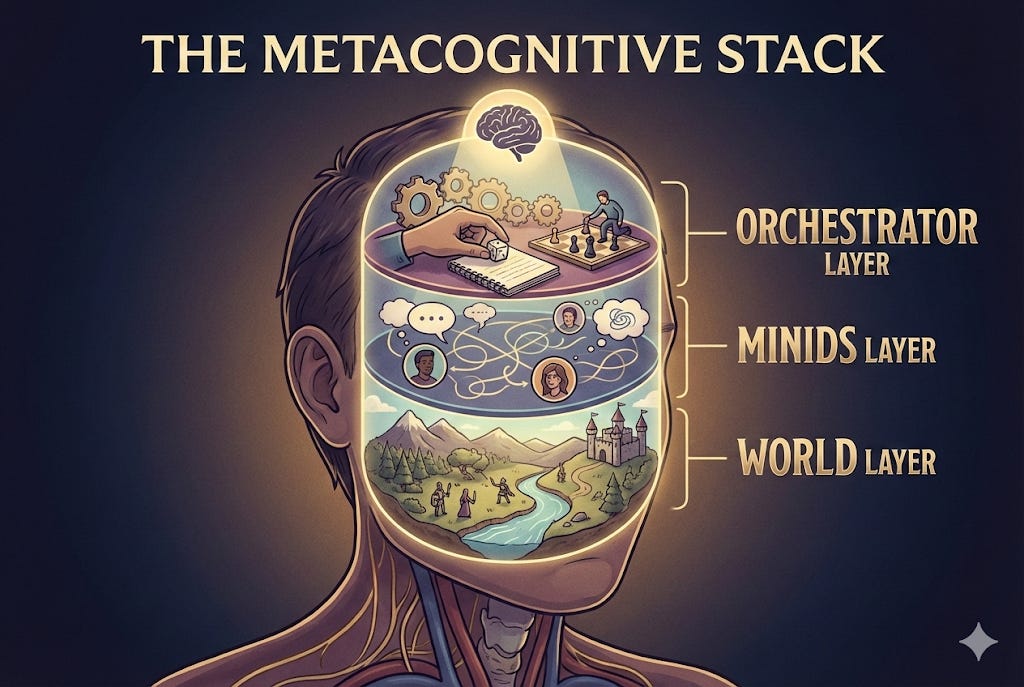
Last week, Raymond Paul Gomez published a fascinating piece about the “Metacognitive Stack”, a framework for understanding what’s actually happening in your head when you play solo TTRPGs. It’s dense with cognitive science terminology, but the core insight is immediately useful: solo play isn’t one mental activity, it’s three distinct modes working together.
I want to unpack this because it names something I’ve been doing intuitively for years without having language for it. More importantly, once you see these three modes clearly, you can use them deliberately to improve your sessions.
The Problem with “Just Play”
Most solo TTRPG advice boils down to “use oracles, roll on tables, journal your results.” That’s fine as far as it goes, but it treats solo play as a flat, undifferentiated activity. You’re simultaneously trying to visualize the world, inhabit your character, track NPC motivations, choose which mechanics to use, and monitor whether you’re having fun: all at once, all the time.
That’s exhausting. It’s also unnecessary.
Gomez’s framework splits this cognitive juggling act into three distinct layers:
The World Layer (First Order Simulation): What’s actually happening in the fiction—the physical environment, cause and effect, what each character perceives
The Minds Layer (Second Order Simulation): What characters believe, intend, and understand—including what they don’t know or misunderstand
The Orchestrator Layer (Metacognitive): Where you step outside the fiction to choose tools, manage your biases, and adjust for fun
Why This Matters at the Table
Here’s the practical payoff: when you consciously separate these modes, you can give each one focused attention instead of trying to do everything simultaneously.
This is exactly what Loner’s core procedure does. When I designed the “Identify what you expect → Test → Interpret → React” loop, I was intuitively structuring these three cognitive modes without having language for them.
Look at how the procedure maps onto Gomez’s framework:
World Layer + Minds Layer: When you “identify what you expect from the scene,” you’re doing two things simultaneously. First, you’re envisioning the physical situation, the environment, who’s present, what’s happening. Second, you’re modeling your protagonist’s perspective, their capabilities (tags), their beliefs, their intentions. This is First and Second Order Simulation work bundled into one prompt.
Metacognitive Layer: When you “test your expectations,” you’re stepping outside the fiction entirely. You’re making tool choices: Do I need the Oracle here, or am I certain enough to just narrate? Do my tags give me advantage or disadvantage? What’s my Chance die vs. Risk die? This is bias management and procedure selection.
Back to World Layer: When you “interpret the results,” you’re taking the Oracle’s output and injecting it back into the First Order Simulation as a new fact. Then “react and continue” restarts the cycle with fresh visualization.
The reason I emphasized making tag decisions “intuitively and not quantitatively” was to keep you from getting stuck in the Metacognitive Layer doing arithmetic. Make your tool choice quickly and return to the simulation, that’s where the actual game lives.
The Twist Counter as Metacognitive Scaffolding
The Twist Counter mechanic is pure Metacognitive Layer work, systematized so you don’t have to think about it consciously.
When you flip a token on doubles, the system is doing metacognitive monitoring for you: “Is the narrative getting stale? Am I falling into patterns?” At six tokens, it forces a disruption by handing you a random twist. This offloads the cognitive burden of self-monitoring and injects surprise without requiring you to generate it through pure creativity.
That’s exactly what Gomez describes: moving metacognitive labor into structured procedures so it becomes automatic over time. The Twist Counter monitors your play and applies corrections, freeing you to focus on the World and Minds layers.
Closed Questions as Second Order Prompts
The closed question structure in Loner’s Oracle does something subtler than it first appears. By forcing you to frame expectations before you roll, it’s training you to:
Model your character’s capabilities and the situation clearly (Second Order work)
Commit to an interpretation before seeing results (preventing hindsight bias, a Metacognitive issue)
Accept constraints on your fabrication (the Oracle forces outcomes you might not have chosen)
When you ask “Can my detective convince the informant to talk?” you’re not just rolling dice. You’re modeling your detective’s social skills, the informant’s likely resistance, the situational context. All Second Order Simulation. Then you’re consciously choosing to offload the decision to dice rather than fabricating an outcome that serves plot convenience.
Recognizing What You’re Already Doing
If you’ve played Loner, you’ve already used the Metacognitive Stack. You just didn’t have terminology for it.
The next time you sit down for a session, pay attention to the rhythm:
Notice when you’re purely visualizing, seeing the scene, inhabiting your protagonist’s perspective, feeling the environment. That’s the World Layer.
Notice when you’re modeling beliefs and intentions, what your protagonist thinks will happen, what NPCs want, where misunderstandings create tension. That’s the Minds Layer.
Notice when you’re choosing tools, checking your biases, or adjusting for pacing. That’s the Metacognitive Layer.
Loner’s procedure already guides you through these modes in sequence. But making the cycle explicit can help you identify where friction happens in your sessions.
If scenes feel flat: You might be spending too much time in the Metacognitive Layer (rolling dice, consulting procedures) without enough time in the World Layer. Try giving yourself 30 seconds of pure visualization before reaching for the Oracle.
If you’re exhausted after short sessions: You might be trying to do all three layers simultaneously instead of cycling through them. Let Loner’s procedure separate them—identify, test, interpret, react as distinct steps rather than one blurred activity.
If you’re over-relying on the Oracle: That’s your Metacognitive Layer recognizing a pattern. The framework gives you permission to consciously decide: “I’m asking too many closed questions. Let me build from established facts instead.”
Where This Could Go
Gomez’s framework doesn’t tell you to change how you play: it names what’s already happening so you can do it more deliberately.
For me as a designer, it clarifies why certain procedures work and suggests where refinement might help. Could Loner benefit from an optional “pure visualization” prompt before identifying expectations? Could twist tables include Second Order disruptions like “An NPC’s belief about your protagonist changes”? Could there be metacognitive check-ins for longer campaigns?
I’m curious whether explicitly understanding these three modes helps you play more fluidly or if intuitive use was already optimal. The framework gives us shared language for discussing what solo play actually requires mentally, which means we can develop more targeted techniques for improving at it.
What parts of your Loner sessions feel most mentally demanding? Does seeing the three-layer structure in the procedure help identify where the cognitive load concentrates?
I bet it felt really satisfying seeing your framework correlating with Gomez's theory. Some good insights there for me. I always feel quite mentally tired after a solo RPG session (part of the reason I have completely switched to rules light RPGs for solo gaming). I may be trying to juggle all three aspects of my game at the same time. I will definitely use this knowledge!
"For me as a designer, it clarifies why certain procedures work and suggests where refinement might help."
Hard to imagine a greater compliment...this is exactly what I was going for. And, in turn, your thoughts about it are sparking new ideas for me. Thanks for the insight!